

Today's guest is Robert Cheatham and we are talking about Japan Earth Observer. This is a newsletter on the space, Earth observation, and geospatial industry in Japan. It is based on a fantastic effort by Robert to systematically collate every last company in the space and earth observation supply chain in that country. Naturally I was drawn to it due to my efforts to do this not only for Japan but every country in the world as the GEO500. We got in touch and exchanged our lists which led to the discussion recorded here today.
The GEO500 has 56 Japanese companies since inception. 7 of them are delisted. So the index contains 49 live positions for this country. All GEO500 positions start with $100. The entire Japanese part of the GEO500 stands at $AUD13,000. This is because the 56 have compounded at 8% annually since inception. In the case of this country, starting as a position in Fujitsu in 2000. The top three performers in terms of capital growth rate are
Terra Drone (125% annually),
Synspective (71%) and
QPS (59%).
The top 3 in terms of value are
Sony ($1100 - bear in mind the $100 starting position, equating to a 20% annual growth rate since entering the index in 2013),
NEC ($960, 10%) and
Raito Kogyo ($760, 11%).
Note that the 3 fastest growers are all earth observation companies, and 2 of those are synthetic aperture radar satellite constellations. This is an exciting part of our industry to watch and I have recorded a couple of great episodes on the power of it. For example,
- Jamon Van Den Hoek's work as an academic partnering with some of the world's largest media organisations to monitor building destruction in warzones and after fires:

- Umbra, a pioneering American SAR satellite manufacturer, they also operate their own constellation:

- Iceye, the equivalent from Finland:

- Ursa Space Systems, a commodity intelligence firm that uses SAR to monitor everything from iron ore stockpiles at ports to oil farm tank lids around the world:

- SeerAI, another analytical platform where I coaxed the guest to use SAR as a way to detect surface change on the NEOM excavation, the world's largest (now abandoned) building site:
SeerAI Responds to Johnny Harris about Neom

Alex Wagner is a data scientist at SeerAI. This is a start up that has produced Geodesic, a spatiotemporal data fusion platform. The discussion was triggered by a video 12 days ago from popular YouTuber Johnny Harris, "Why Saudi Arabia is Building a $1 Trillion City in the Desert":
But this wasn't just about current companies. We were privileged in this episode to be given a history of Japan's trading houses since the 1860s to today:
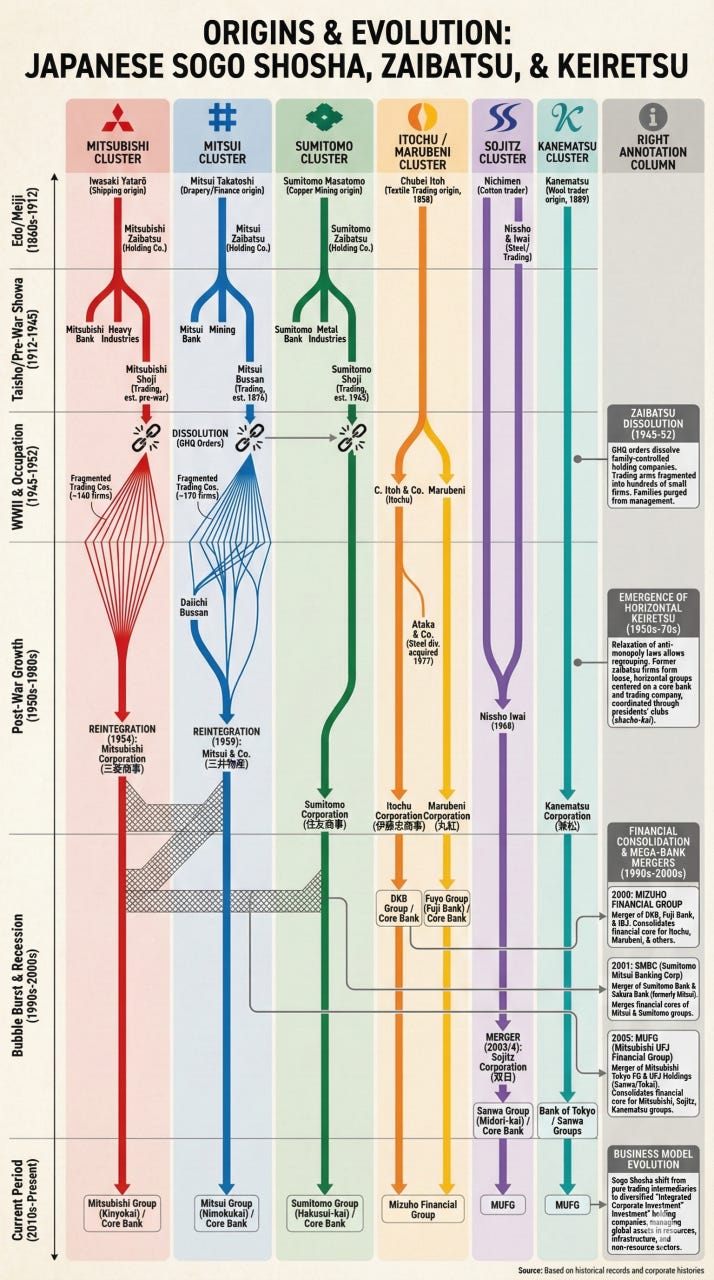
This led to several insights around the longevity, for example, of the social groups that comprise such firms and how they can persist even through a trust busting effort by the winning country after a world war. Another insight was the benefit to society of trust busting and how it unleashed a wave of new companies and from that household names such as Honda and Sony. Honda recently launched a rocket that was able to land itself. This has relevance to possible future earth observation constellation launches. Sony released LiDAR solution in 2013 and also sells other geospatial products like a GNSS chip. We have come full circle.
There is rising social unrest due to monopolies in the US. Robert’s comments help us to see the benefit of a round of trustbusting to solve it.
A final note about Robert himself. We are presented here with a cultivated and successful entrepreneur. He grew a geospatial software development firm to 50 people then sold it. He has learnt a foreign language well enough to spontaneously translate things for me during a podcast recording without warning. He also is able to offer a comprehensive historical view on the emergence, development, setbacks and modern day expression of several dominant companies in a vibrant foreign economy, Japan.
He shows us the way then, on multiple fronts. I am grateful for the chance to put an inspiring industry figure in front of you today.
Thanks Robert.


