

SCIENTIFIC CONTEXT
Mark Baumgartner is a senior scientist at Woods Hole Oceanographic Institution. Back in 2011 he and Sarah Mussoline published a paper on how to use computer science to classify whales from sound recordings. This episode is about an evolution of that software by Atle Borsholm from NV5 Geospatial.
GEO500 CONTEXT
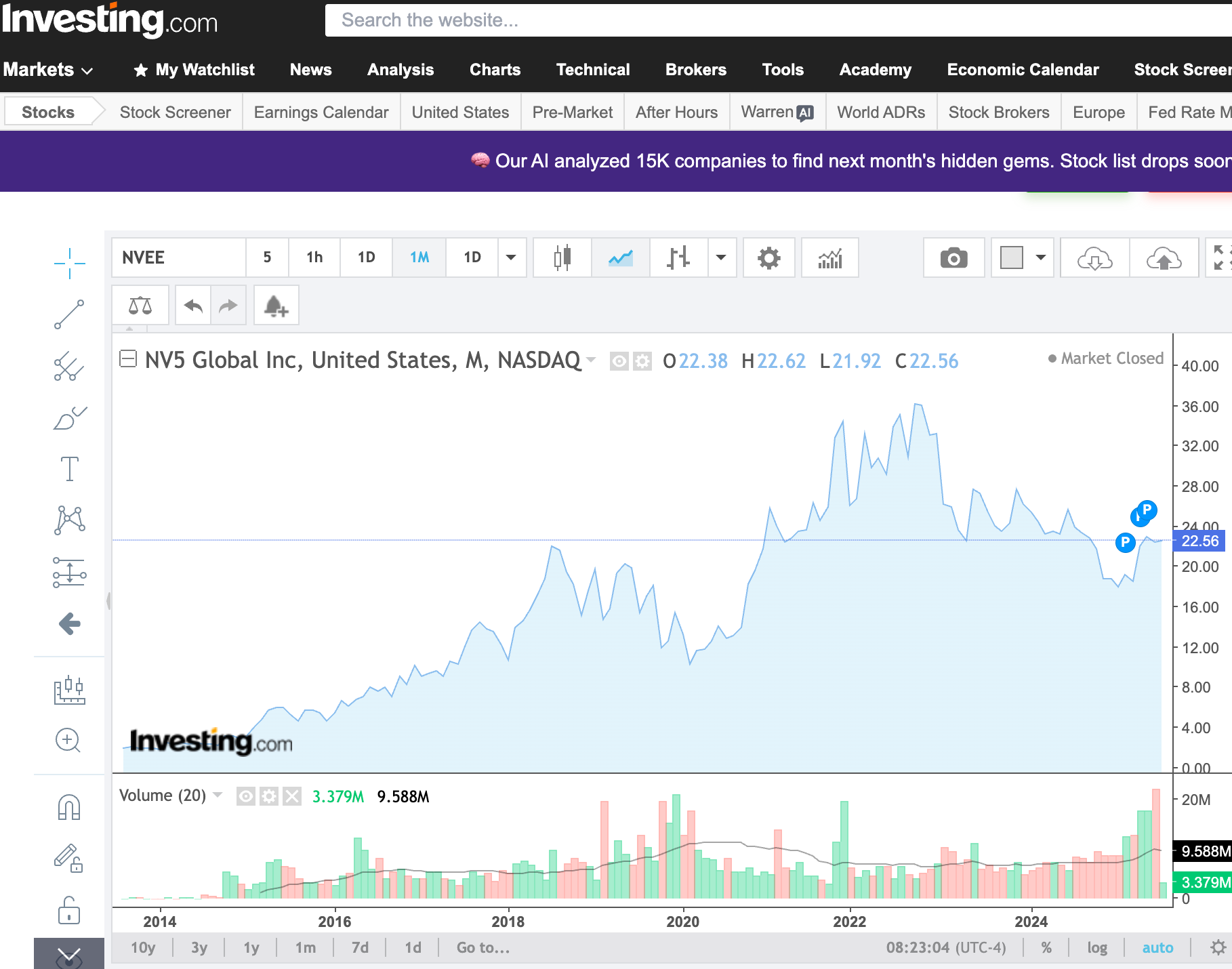
NV5 Geospatial is owned by TIC Solutions, a $1.85B publicly traded company: TIC 0.00%↑. As such, it is a huge achievement for the podcast to be profiling a component of the GEO500. Like a lot of these companies, there is a convoluted acquisition history. They were under the ticker NVEE as the fast growing engineering consultancy NV5. NV5 purchased Quantum Spatial in 2019. As that was a geospatial acquisition by a non geospatial company prior to this, NVEE went into the GEO500 under Rule 3. Unfortunately this meant the index didn’t get the full stellar NVEE compounding run from 2013:
More M&A happened: 4/8/2025 Acuren bought NVEE for $1.7B. The combination was then renamed TIC Solutions and I kept them in the Consultancy vertical on account of the kind of work the guest tells us about today. They have since dropped 30%:
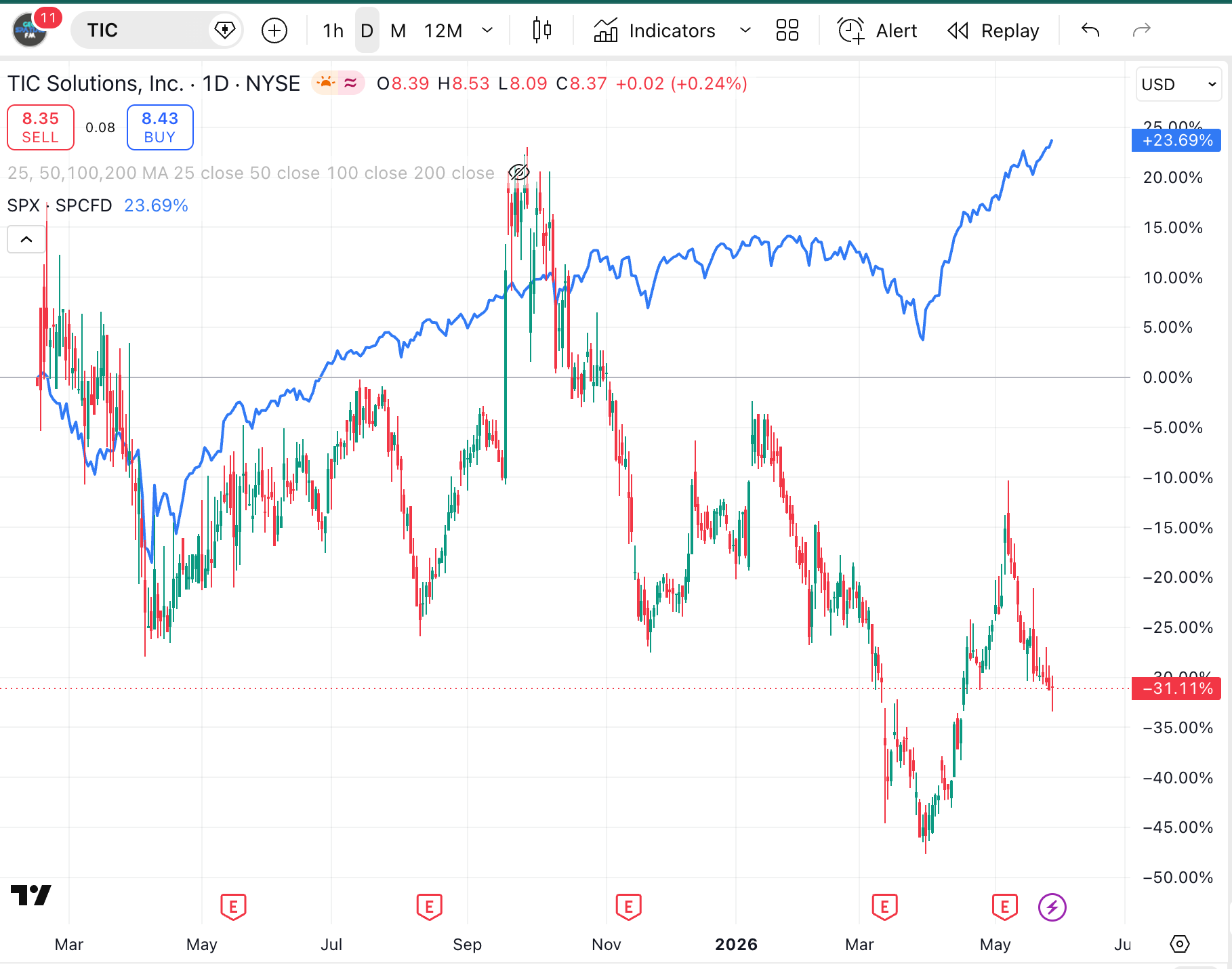
Over the same period, the S&P 500 has gained 24%, the GEO500 gained 29% and the GEO100 gained 27%. TIC Solutions is overall mostly an instrument testing company. 2025 revenue was $1.5B and $1B of that was in the Inspection and Mitigation segment. Consulting Engineering: $300M. Geospatial? Only $100M. For the purposes of the GEO500 then, TIC Solutions is a consultancy. Since TIC was listed, the consultancy vertical of the GEO500 has lost 6%.
So TIC Solutions have underperformed in all respects.
What is the upside here? Learning. IPOs almost always lose money in the first year. TIC Solutions is no exception. Let us use this to put ourselves in an informed position about the SpaceX IPO set for 2 weeks from now, 6/12/2026. Not worth listening to some random Substacker? How about Buffett making the same point about IPOs, with regard Uber’s:
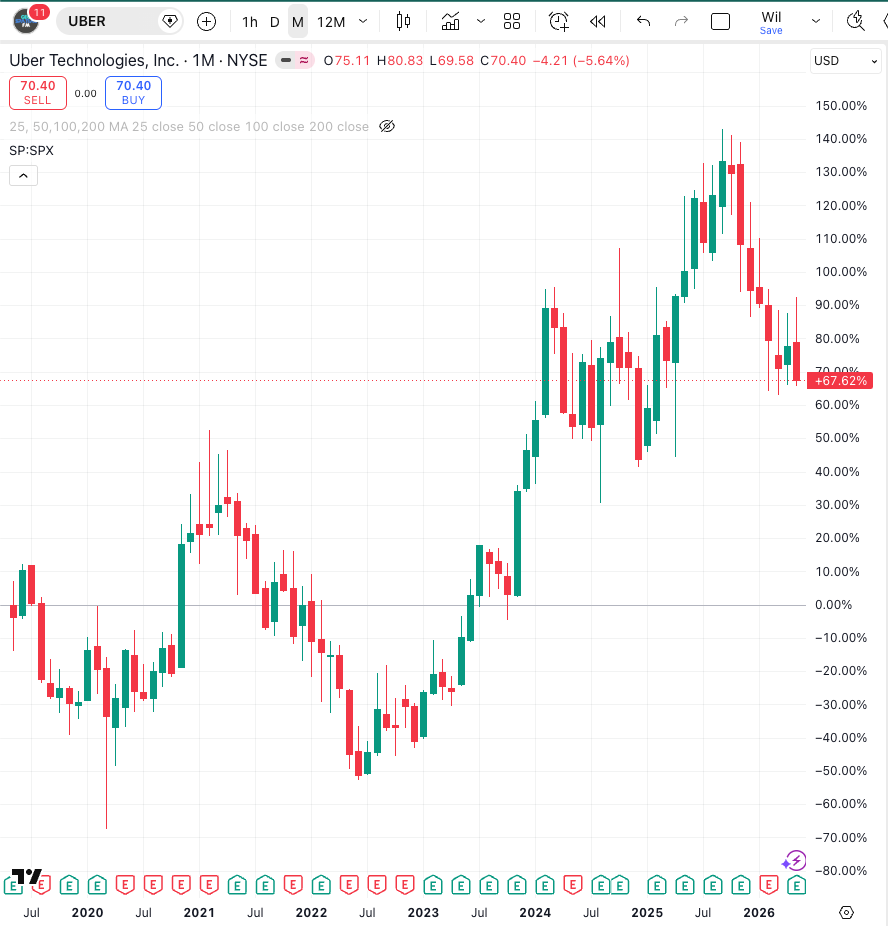
UBER 0.00%↑, as shown below, was underwater from its IPO for fully 18 months, at one point down 67%:
Buffett:
We like to buy things where nobody’s making a dime selling them to us.
Ok, back to the show.
HYDROPHONES
At the beginning of the episode you will hear a sound recording. Take a listen and attempt to classify the whale making the calls in it. In my comments at the end of this I’ll tell you what whale that was. It was an easy one to process - the recording was just 7 seconds long and a whale sound was present immediately. Consider if I instead gave you another one lasting a day and most of it was just ocean noise. This leads to the challenge discussed in today’s episode.
Imagine I have 100 microphones under the ocean. These are called hydrophones. These hydrophones record for 24 days. The scientists managing them will say they now have 2400 days of data to process. Well, that is nowhere near how big of a challenge this episode is about. The National Oceanic and Atmospheric Administration had 217,197 days of hydrophone recordings going back 20 years. Whilst Mark’s software was available, it needed to be made more efficient to process all this data.
It was worth the effort. It turned out that only 24,000, or 11%, of those days involved a whale being detected. All of it is shown on NOAA’s Passive Acoustic Cetacean Map. Atle starts by discussing a web application, Mark’s Robots4Whales website, in our episode today.
AGI
The whale at the start? It was a humpback whale. I tested the most popular 3 AGI platforms with this whale call, Claude, ChatGPT and Gemini. Only Gemini managed to classify it correctly. Nevertheless, it makes one expect that in another few months probably the other 2 will start getting the classification correct as well. This is a threat to the geospatial consulting industry. I expect NV5 made a decent amount of money enhancing Mark’s code. If they’re going to get eaten up by a free AGI platform, however, then their leadership must be having some robust discussions about the future at the moment.
Thanks Atle for the stimulus and for NOAA signing off on the publication of this episode. It is a privilege to have reached the point of sharing this kind of work.
Links for further reading
NV5 article on Harnessing Data Science for Marine Conservation
NV5 article on IDL® Software Extract Meaningful Visualizations From Complex Numerical Data
Woods Hole article on whale sound detection and classification


