

None of this is investment advice.
INTRODUCTION
An emerging market is a term in western finance for more advanced developing countries like China, India and South Korea.Kevin Carter is today’s guest, and he has a couple of decades of experience investing in emerging markets as founder of EMQQ Global and EMXETF. He appeared on CNBC talking about some of this last year:
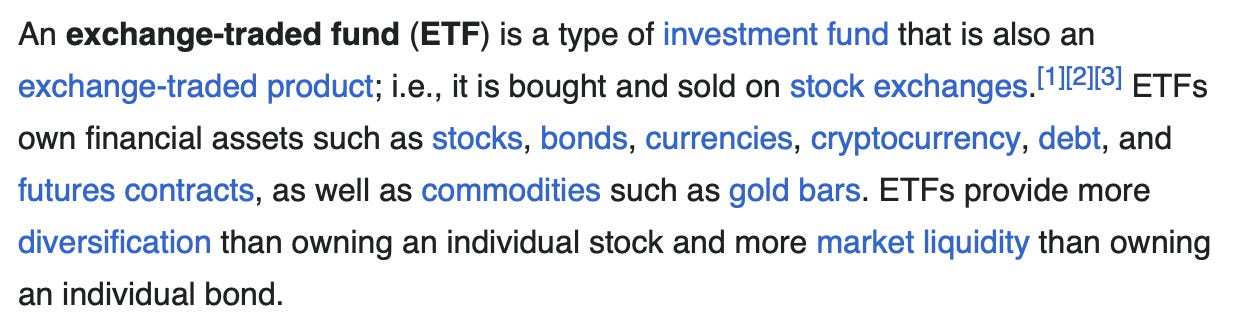
He has been prolific starting exchange traded funds, Wikipedia explains what they are:
These are the ones he started that still operate:
CQQQ 0.00%↑ - Chinese tech equities
INQQ 0.00%↑ - India’s digital consumption and online commerce
EMQQ 0.00%↑ - online consumption platforms across developing nations
FMQQ 0.00%↑ - tech, digital payment, and e-commerce in frontier markets
AICH 0.00%↑ - China's broader AI ecosystem
TGRZ 0.00%↑ - Chinese AI "unicorns" + tech giants with LLMs
And here he is ringing the bell at the NYSE launching EMQQ:
Cool, so what did we talk about?
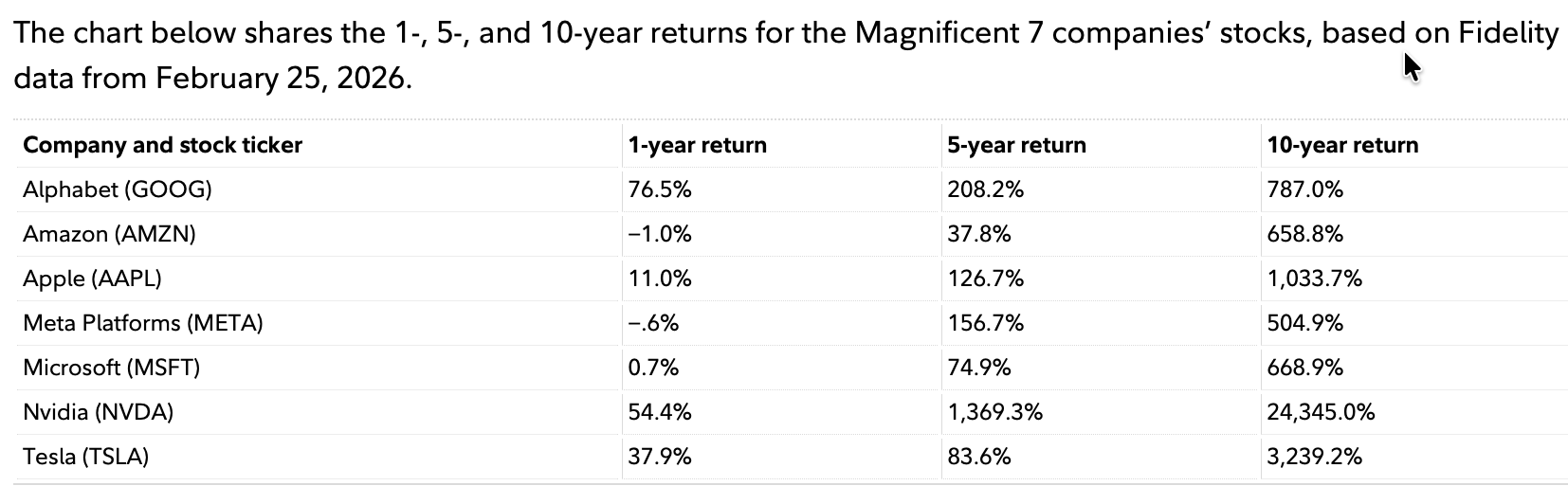
MAG 3. You’ve probably heard of the Magnificent 7. If not, Fidelity to the rescue:
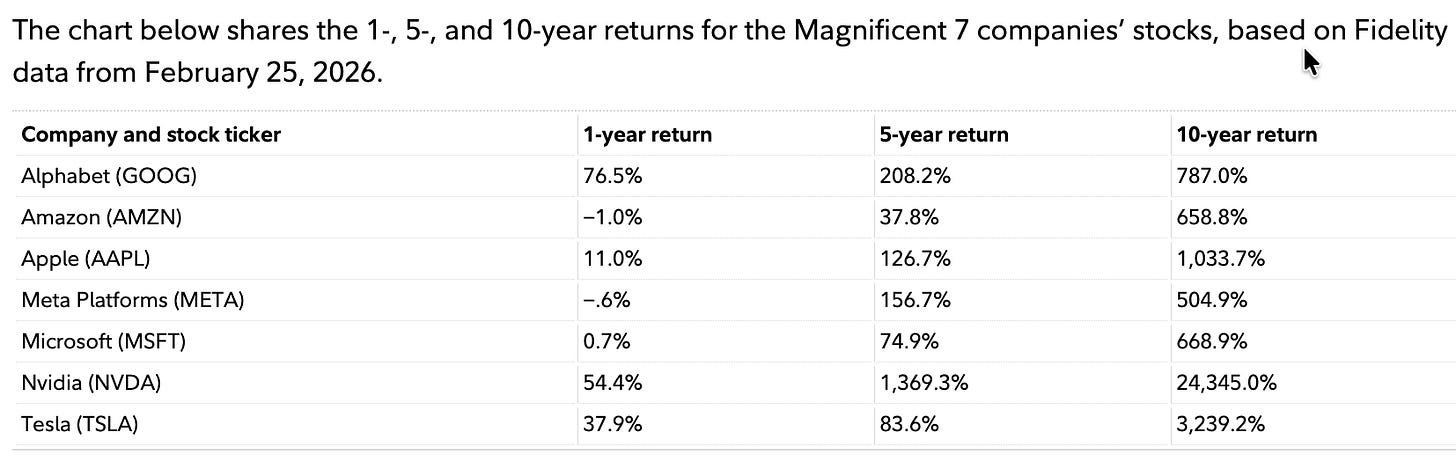
These are stocks from what the West calls Developed Markets. Kevin talked about applying the same idea to emerging markets, he found The MAG 3.
Then we moved on to China’s AI Tigers. Kevin challenged our assumptions about US AI leadership with stories from China.
Finally, we covered how to create an exchange traded fund or ETF. This matters because there isn’t one for geospatial yet.
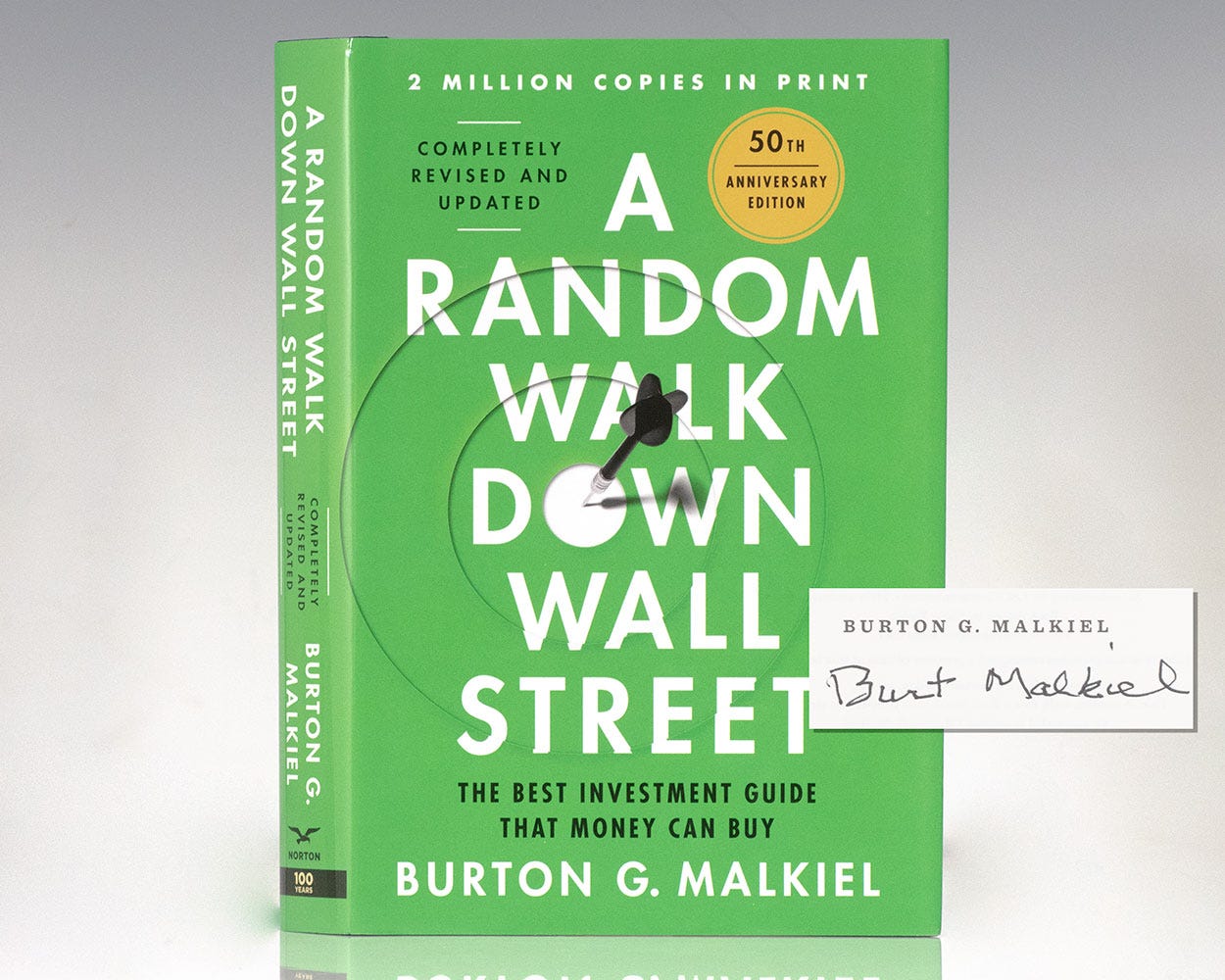
Burton Malkiel is an advisor to Kevin’s EMQQ Global ETFs. He wrote the famous book A Random Walk Down Wall Street, Kevin was nice enough to send me a copy before this episode:
Something Kevin was impressed with was spontaneously showing him my global stock exchange Google Maps list:
I’ve since classified this into various types of markets, keep reading.
IMPLICATIONS
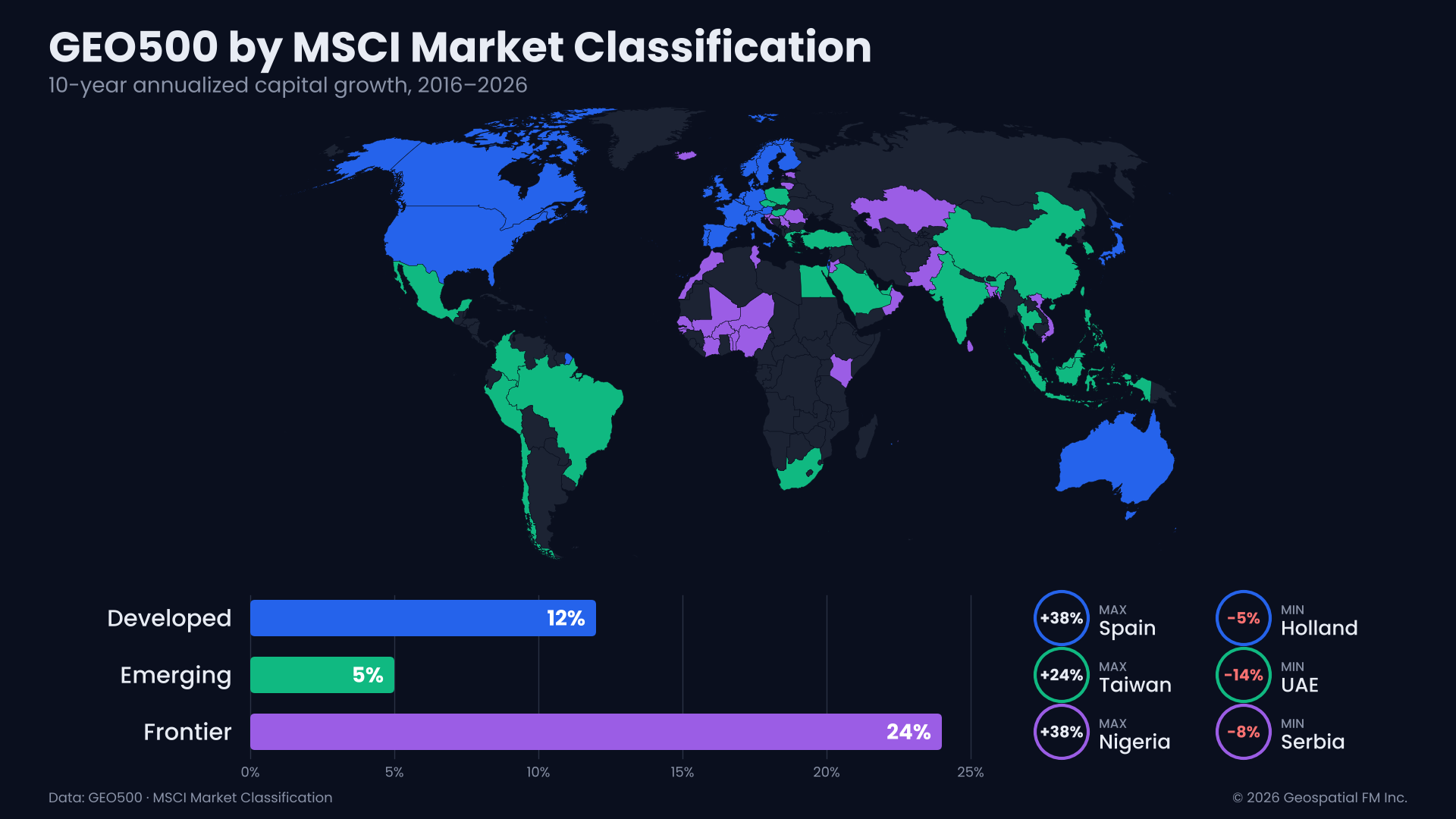
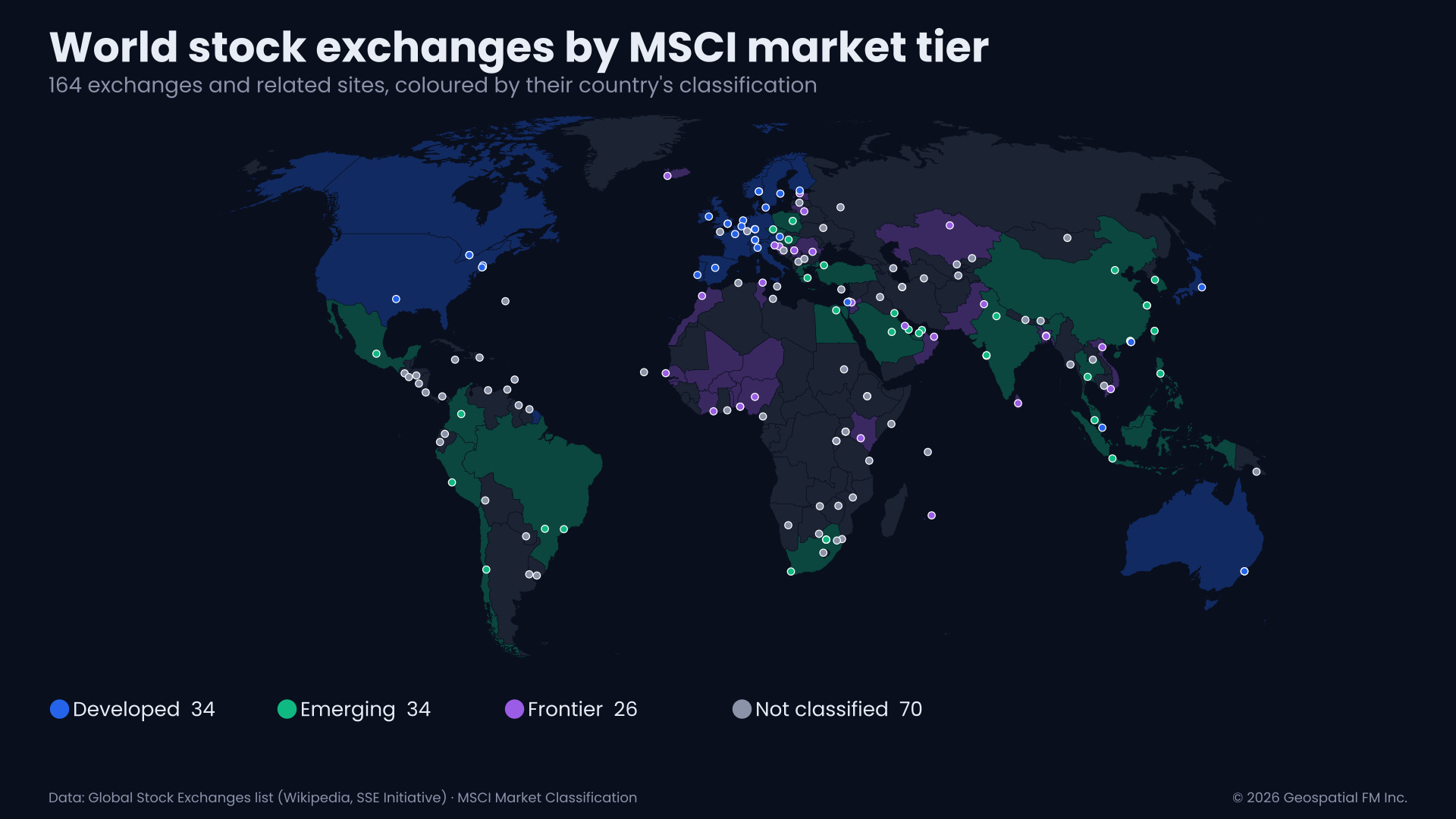
So what’s the obvious thing to do inspired by Kevin’s work? You guessed it, I classified the GEO500 into frontier, emerging and developed markets using MSCI’s latest classification. This joins the ranks of many other classification layers. The ones added before this are leadership type, being an Esri partner, being in the Geoawesome Top 100, pureplay vs adjacent geospatial, not to mention the 29 geospatial industry verticals I have assigned. All offer useful insights on the GEO500, let’s look into the details of the new developed, emerging and frontier markets classification.
Developed Markets
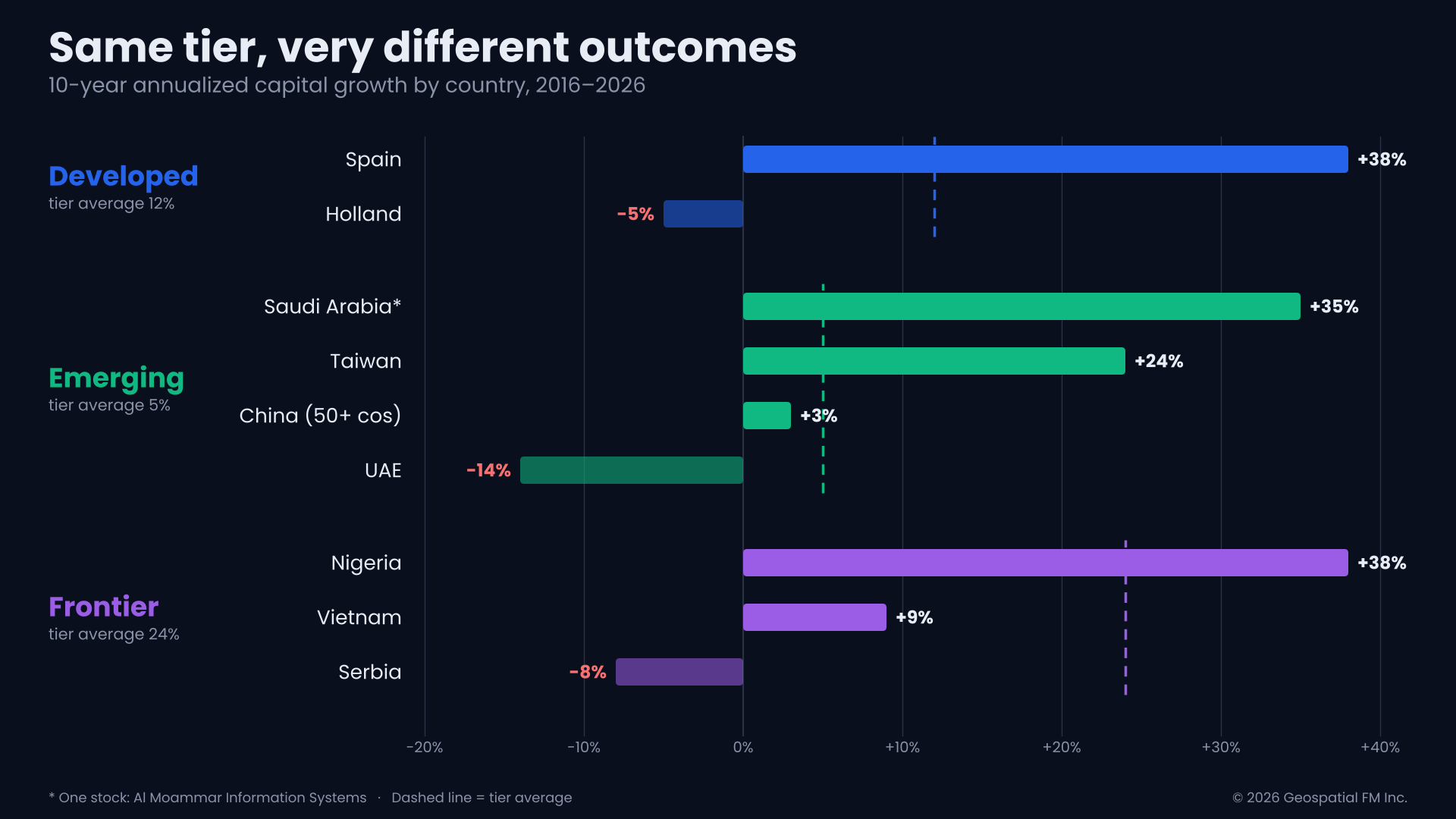
The results for developed markets were 12% capital growth per annum, on average the past decade. Best performing country was Spain at 38% annually. Holland was the worst at -5% annually.
Emerging Markets
For emerging markets it was vastly less, 5% per annum. Best country was Saudi Arabia at 35% annually but this was just one stock, Al Moammar Information Systems. The next best performing country was Taiwan, at 24% annual growth. The worst was the United Arab Emirates at -14% annually.
Frontier Markets
It was a much better picture for Frontier Markets, with 24% growth per year on average the past decade. Best country was Nigeria at 38%, worst was Serbia at -8%. I only cover 3 frontier markets countries though, the third is Vietnam, whose geospatial stocks grew at 9% annually in the past decade.
Emerging markets being worst of all is an interesting outcome for the GEO500. Kevin’s comment seems to apply here about the risks of former state owned enterprises on emerging markets stock exchanges. For example, there are upwards of 50 Chinese companies, together they have only grown at 3% though. This implies we need to pay some attention to selection of emerging markets stocks and not just buy them all.
We have come full circle. Kevin sent me a book about picking stocks and the author is an advisor to one of his investment funds. Is this enough to avoid the default outcome of low returns from emerging markets?
I am reminded of another podcast guest, Henk van Houtum:

He also sent me a book, one he wrote called Free the Map. It challenges the validity of national borders as the default map of the world. He reflects that having national borders as the primary image of the world reduces our ability to humanise everyone to the same degree.
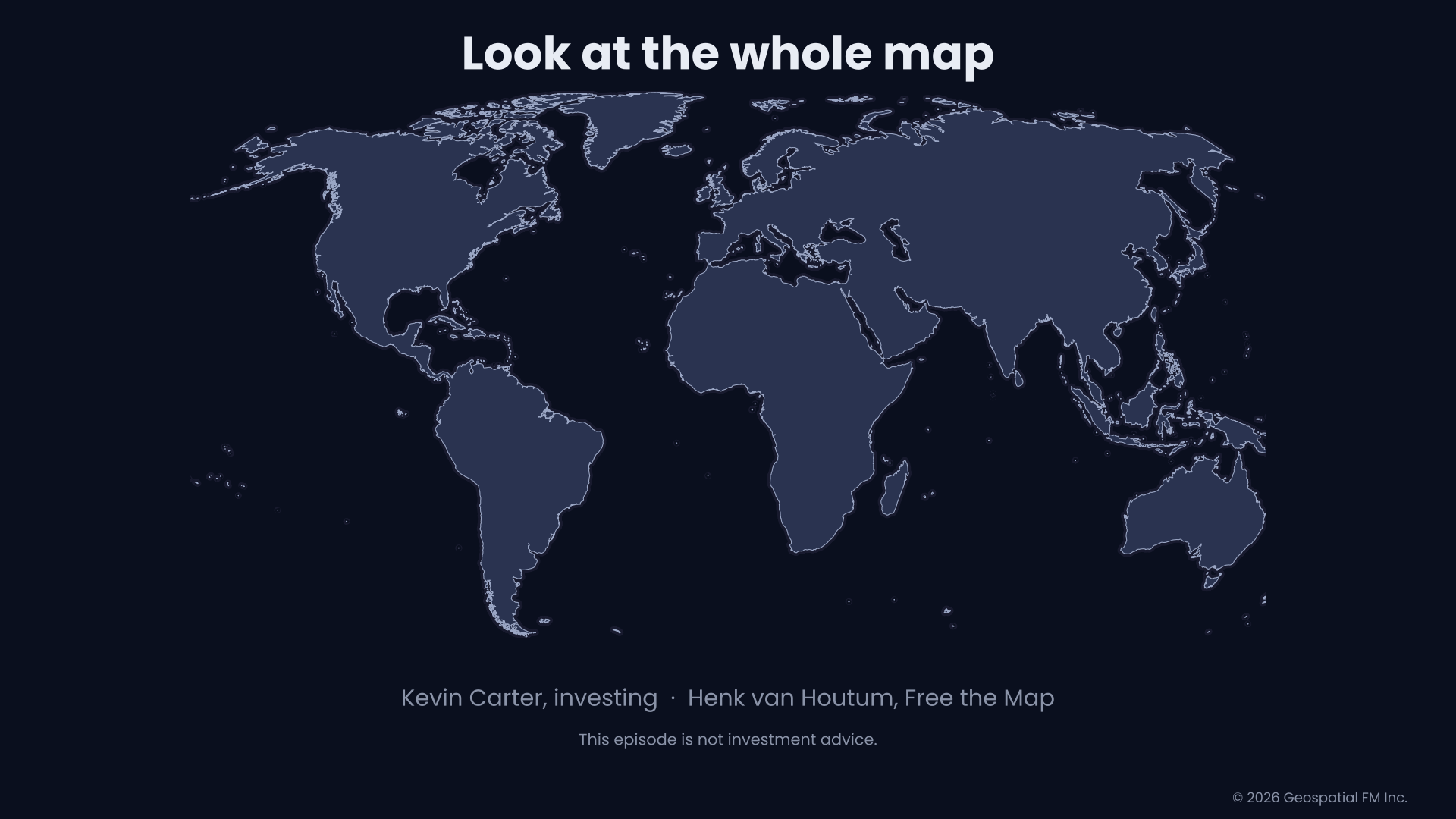
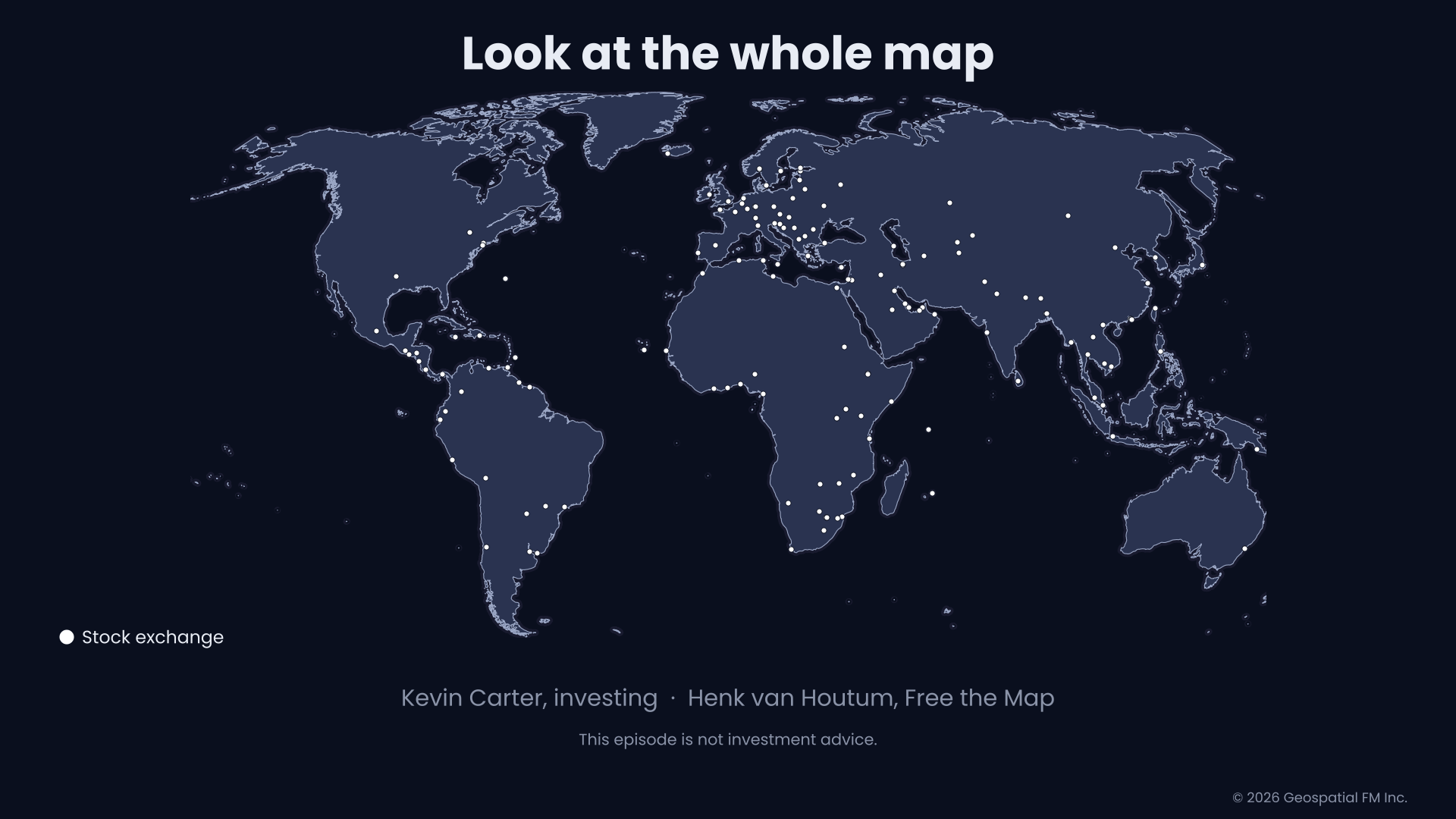
Via finance, of all things, I see Kevin doing the same thing.
Kevin has been nothing but a cheerleader of emerging and frontier markets for decades. He was a pioneer in making them easy to invest in via an exchange traded fund. His marketing activity around his funds, evident in this podcast, show nothing but admiration for these countries and a celebration of the incredible companies they can produce. The recent dominance of the Magnificent 3, all from outside what the West calls the developed world, is an emphatic endorsement of his long term commitment to finding investment ideas outside traditional markets.
It is funny then to see that via finance, Kevin effectively endorses the work of a Dutch political geographer on the other side of the world. Through the earlier episode with Henk, you saw that he does not mince words spotlighting the humanity of people regardless what border they happen to have been born within. Henk asks us to produce maps that offer everyone humanity. Kevin echoes this in saying he looks at the WHOLE map of the world in his investment search.
Once again, this episode isn’t investment advice.
You should consider other options: FRDM 0.00%↑, VOO 0.00%↑.


