

NAVIGATION
YOU’RE HERE > Chapter 1: Introduction.
Chapter 2: Definitions: several moral injury definitions exist based on the horrors confronted by soldiers and medical workers, I find the one that resonates.
Chapter 3: Diagnosis: I take the MIOS F to score my moral injury severity, and discuss the implications of a study showing a drop in reasoning capacity for those with moral injury.
Chapter 4: The Moral Transgression Immune Response: reflections on keeping myself from success.
Chapter 5: The Way Out: working through the sense of betrayal that drove my moral injuries and the responsibility I assumed that wasn’t actually my weight to carry (hat tip Wendy Dean, MD of Moral Injury of Healthcare).
INTRODUCTION
Let me describe one of several moral injuries that has happened in my career. It was 2017 on a construction site for a Middle East country’s national oil company. The project management consultancy that employed me was a top 5 multinational engineering firm. A large, multi-storey, factory-sized oil processing facility was being built. One weekend, a construction worker hung himself on it. When his body was discovered, the worksite was not shut down. Staff were invited to leave if they wished to. Unthinkably, not all did. A perimeter was put up around the body. Whilst they waited for the police to arrive that afternoon. Despite that, from some parts of the site, workers could still see his hanging body. Compounding the moral transgression, it was declared by the oil company not to be a safety incident. Justified as occurring on the weekend. The operations director at the project management consultancy (PMC) stated, during a subsequent town hall in front of 300 people, that the company would not contest this assessment. The thought of a swinging dead body at a site where one might be working haunts me to this day.
By the way, if you want more detail on all of this you’re in luck. Here is my earlier testimony about the parts of my career in Phnom Penh and Kuwait:
The link should start the video at 42:22. Skip forward to that point if it doesn’t. The testimony continued here:
Let me describe another moral injury. Same year. Same client. Same project management consultancy. There was a young Indian electrician employed by a staffing agency. He’d only been in the country 4 months. As his training required, he caused an evacuation of 160 workers due to detecting an H2S gas leak. If you don’t understand the significance, Landman explains:
He and 4 others went to hospital on account of beginning to choke on the gas. His life was saved. He was then fired. When I checked, there was no record of the incident put in the client’s safety database.
Using his personal email account, he appealed the injustice of his dismissal to client, PMC and staffing agency leadership. He attached hospital records verifying he would have died without treatment. The buck was passed around. He was deported from Kuwait back to India. 20 days later his email made its way to me via safety staff colleagues. I was mindful that most Indians go to Kuwait with a debt to Indian recruiters of a year’s anticipated salary in Kuwait. Far higher than in India. I was haunted for years by his never replying to my several attempts to reach out via his personal email address. I was mindful of his being confronted with having to repay that debt on a pitifully low salary back in India. Further, I was mindful of his likely being ashamed of returning home merely 4 months after departing. With nothing, indeed less than nothing, to show for it. The thought crossed my mind, with his failure to respond to my emails, that this young man may have chosen to end his life. Like several others had during my time at that PMC.
If you want extra detail on this, skip forward to 8:09 here:
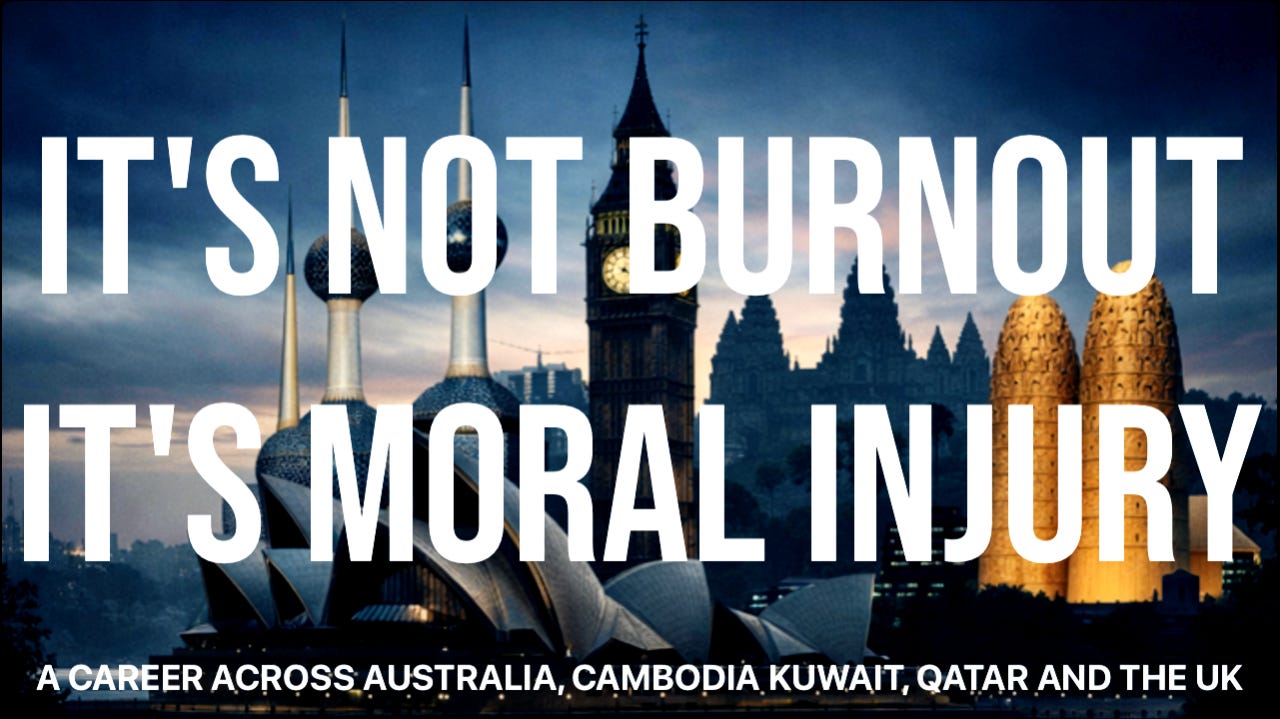
These are just two of several moral injuries that have occurred in a career spanning 6 countries since 2011. A moral injury is haunting and life destroying. Its impact on me has been powerful and complex. I was not the only one affected. Therefore, another reason to spend the time here to speak out publicly is that it may benefit more than just myself. I have a 5 part plan and, don’t worry, the definition of moral injury is next:
Chapter 1: Introduction (you’re here).
Chapter 2: Definitions: several definitions exist based on the horrors confronted by soldiers and medical workers, I find the one that resonates.
Chapter 3: Diagnosis: I take the MIOS F to score my moral injury severity, and discuss the implications of a study showing a drop in reasoning capacity for those with moral injury.
Chapter 4: The Moral Transgression Immune Response: reflections on keeping myself from success.
Chapter 5: The Way Out: working through the sense of betrayal that drove my moral injuries and the responsibility I assumed that wasn’t actually my weight to carry (hat tip Wendy Dean, MD of Moral Injury of Healthcare).
Thanks for joining in, see you in the next part.