

CAUTION
This article contains graphic descriptions in text and video of workplace safety breaches.
NAVIGATION
YOU’RE HERE > Chapter 2: Definitions: several moral injury definitions exist based on the horrors confronted by soldiers and medical workers, I find the one that resonates.
Chapter 3: Diagnosis: I take the MIOS F to score my moral injury severity, and discuss the implications of a study showing a drop in reasoning capacity for those with moral injury.
Chapter 4: The Moral Transgression Immune Response: reflections on keeping myself from success.
Chapter 5: The Way Out: working through the sense of betrayal that drove my moral injuries and the responsibility I assumed that wasn’t actually my weight to carry (hat tip Wendy Dean, MD of Moral Injury of Healthcare).
INTRODUCTION
First up, writing about this is extremely hard. I’ve been the kind of person who viewed the word ‘trigger’ as something snowflakes used. Well, in trying to write this, I was triggered. It’s real. I am trying again for the second time to write about this after getting nowhere a couple of hours ago. This is because I watched too many videos of broken soldiers crying about trauma. So, heads up, you’ll be seeing some of those videos below as part of exploring this topic.
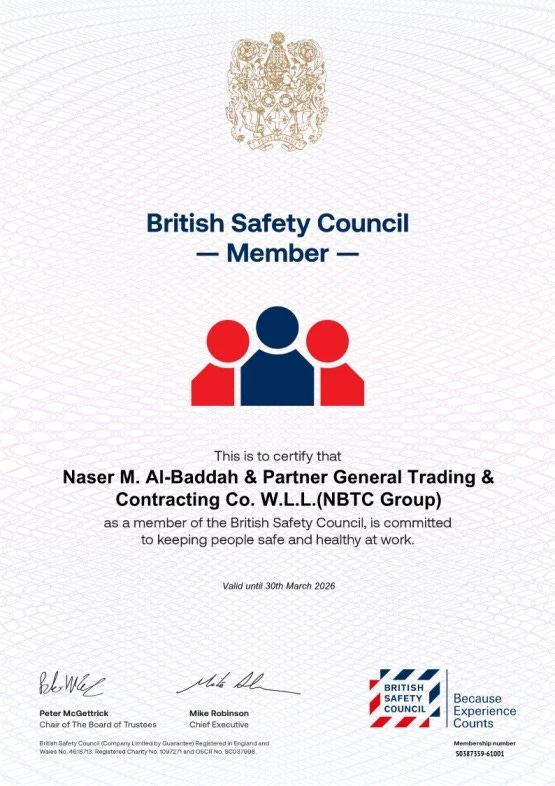
In the introduction I gave two example events that lead to moral injuries for me. Let’s get some more material in front of us to motivate thinking about a definition. I will start actually by adding some extra details to the second example I gave in the last piece. In short, I bore witness to no one saving a likely indebted young Indian from getting fired in Kuwait after evacuating a work site because of an H2S gas leak. He and others had to go to hospital to save their lives. I also missed the chance to save him myself due to not being informed before he was sent back to India. Despite everything I tried to do anyway, such as an ethics report to the PMC (resulting in the Global Compliance Officer James B. Walker telling me he flew down to Kuwait from London), contacting Kuwait Oil Company leadership and appealing to Bibi Nasser Alsabah, a Kuwaiti princess, no justice was served. On June 29, 2017 I even emailed British Safety Council about the case (happy to provide the evidence if you ask). This is because the manpower company that fired him, NBTC Group, displayed a membership certificate on their website, signed by Lynda Armstrong and Alex Botha:

I got no response.
Once again I had the feeling of failing to be able to do anything to help. And that continued in one final fashion, 7 years later in 2024:
Source: Google Maps before NBTC Camp 4 was removed some time in 2025. At the end of the video you can see where the place mark used to be.
This video is NBTC Camp 4 burning, 50 men died. It was living quarters for employees of NBTC. Men like the fired electrician slept there. I could not escape feeling that if this company had been disciplined in the way I tried to cause in 2017, then the lax safety standards leading to this fire in 2024 killing 50 men may not have happened. For example, if British Safety Council made them take down the membership certificate after I contacted them. Until they improved their safety standards. Instead, I discovered there was an updated version of the certificate valid through March 2026, then one till 2027 currently on their website! They are signed by Mike Robinson and Peter McGettrick:

Try that for a compounding, years long moral injury. Hell, I didn’t even know about the fire until I had the bad luck of trying to put all of this behind me last year in a series of video testimonies:
... only to come across this fire in the course of researching NBTC. I felt connected to the fire. I literally felt that my failure to cause justice for this man was part of the train of events to lead up to those men dying. Really what happened though is that I failed in fighting through all the other disinterested, negligent people who lead the organisations involved. On proper reflection, they bear true responsibility for this appalling scene. Speaking of which, whilst we’re on Kuwait, try reading about this other major fire in the country’s history:
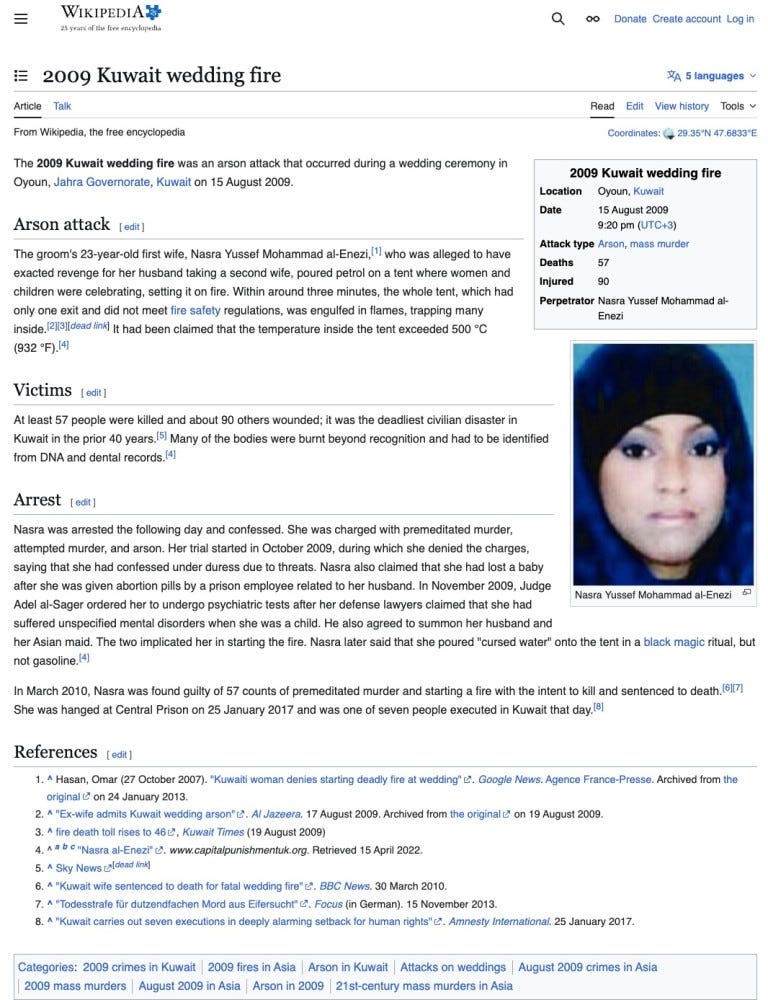
That’s right, Kuwait’s approach to marital relationships produced an enraged first wife who set 57 women and children on fire during the husband’s wedding to a second wife. The first wife was then executed. After having a miscarriage in prison. The execution happened during the last year I was there and it is only today I’m finding out about it. I believe you now have a wholistic understanding of how Kuwait is a robust, high velocity production line for moral injuries. And how an institution from another country, British Safety Council, has failed to put a stop to some of them. A quote from all membership certificates:
[NBTC Group] is committed to keeping people safe and healthy at work.
These membership certificates, over a 10 year period, have accompanied the unjust firing of a vulnerable young staff member for following his safety training, and the subsequent deaths of 50 men after my efforts to blow the whistle fell on deaf ears.
Now, I was going to diligently put before you examples from other people of traumas that lead to moral injuries but I think I have enough material to move directly to definitions. What I will do though is throw a few videos in front of you. If you want to watch soldiers testify so you understand the meaning of grit and a sense of humanity:
A telling quote from Joshua: “Shame, powerlessness, betrayal and guilt. When those emotions are allowed to manifest, they can do so in a catastrophic fashion that can have devastating consequences on your personal life, your families, your friends and your loved ones.” Oh how I know. He now runs West Breath.
One final dose of soldier testimony:
We will use a slide from Steve’s talk below when discussing definitions. This gentle man.
DEFINITIONS
As stated by Joshua above, moral injury creates a profound drain on a person. You would not believe how much enthusiasm it can snuff out (this will be detailed in part 4). The definition of moral injury has evolved over time, this is from Dr Shay, responding to traumatized veterans:
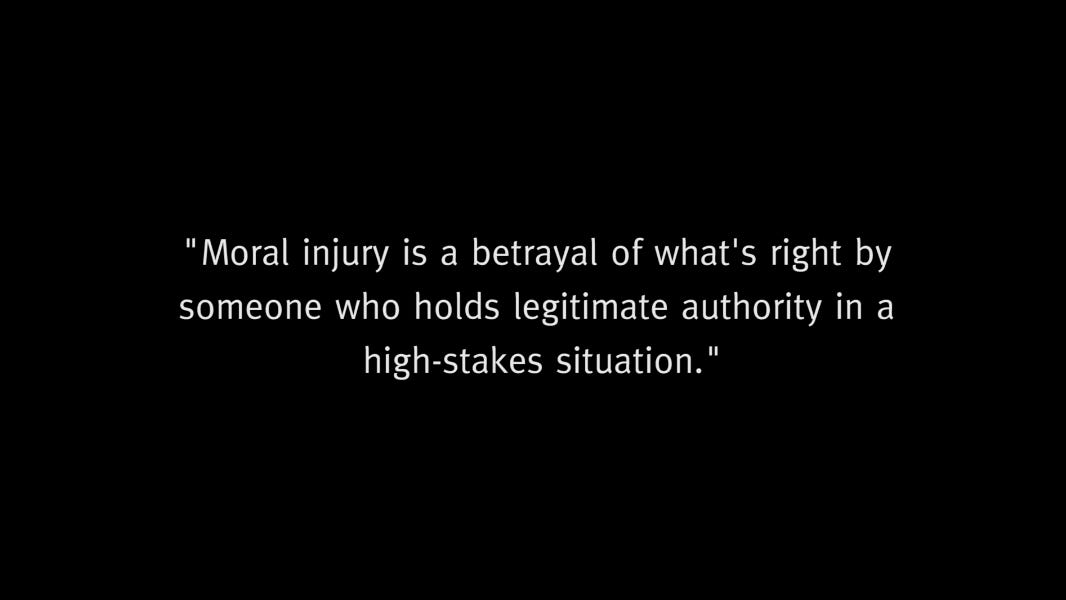
Source: (now shuttered) Shay Moral Injury Center started by Rita Nakashima Brock at Volunteers of America:
In further work with veterans, a new definition was offered by Professor Brett Litz (source):
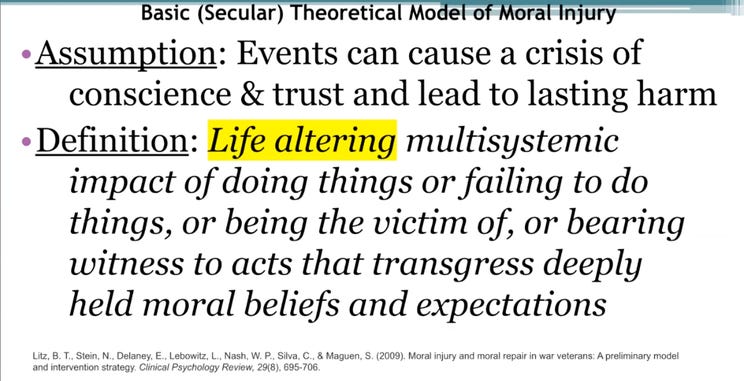
You can see this newer definition lacks the punch and pragmatic language of Dr Shay’s one. It offers acknowledgement, however, that such an injury can happen to unexpected groups: those who fail to do something in response to, or who witness betrayals of what’s right. On the cause, see below quote from Professor Litz. It appeared in Steve’s talk shown above, source:
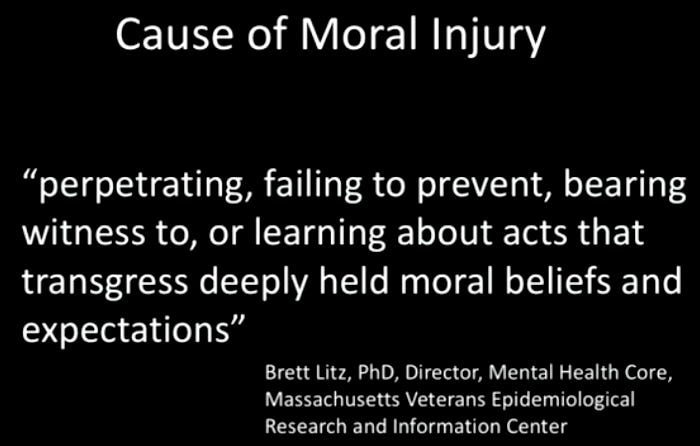
The concept ‘failing to prevent’ is exactly what happened to me. You can see it in my repeated failures to help a young man who was fired under circumstances that were a textbook betrayal of what is right. The item ‘bearing witness to’ also applies to me and hundreds of others at the PMC where I worked. This occurred when we got news of the man who hung himself at a worksite in combination with the leadership betraying what is right by saying it was not a workplace incident. Oh, along with the simple horror of knowing that we worked for an organisation that did not shutdown the worksite in the presence of a hanging body.
Looking at the most up to date definition I can find, the latest study on moral injury is The impact of moral injury-related content on reasoning and its neural correlates: Data from the Canadian Armed Forces (CAF). It was lead by Oshin Vartanian. It begins with this definition:
...the functionally impairing psychological, biological, spiritual, behavioural, and social impact of perpetrating, failing to prevent, bearing witness to, or being a victim of acts that transgress deeply-held moral beliefs and expectations.
We are at a definition resonates with me. As already stated, the ‘failing to prevent’ and ‘bearing witness to’ aspects speak to my injury. Over a 16 year multinational career in some terrible places I have, it is important to say, not been a soldier. I do not wish to steal any valour. Shay’s definition does not therefore apply to me. I had a choice to disobey orders. And I vigorously did so. Soldiers cannot disobey orders. This puts them at the mercy of leadership malpractice: legitimate authority figures betraying what is right in high stakes situations.
What does apply to me is the evolution of the definition by Professor Litz and applied here by Vartanian. Regarding acts that transgress moral beliefs and expectations about the dignified treatment of others that any person would have, I have variously failed to prevent them (despite desperately trying), and I have born witness to them. I saw this in the guilt and shame I experienced in failing to prevent the Indian electrician getting fired and sent home. You can also see this in the traumatic horror I experienced as a witness to the shocking case of a man hanging himself on a worksite and its not being shut down for the day. Whilst the body swung from a pipe rack waiting for the police to pick it up.
In the course of failing to prevent a moral betrayal affecting others, I have also experienced moral betrayal against myself by those in a position of authority during 2023-2024. Yes, I was victimised in standing up for others. Hence the aspect ‘being a victim of acts’ applies to me also. I am still figuring out how to write about this. I’ll leave it for now. I have at least begun by recording a couple of videos about NEOM and and a couple of Dallas cowboy engineering outfits, AECOM/Jacobs:
Right, so now that we’ve gotten through some definitions and identified the parts of a contemporary one that relate to me, it’s worth turning our attention to a talk by Professor Zachary Steel:
An incredible amount of work has gone into this presentation, such as the slide on definitions that he pulled from Moral Injury and Definitional Clarity: Betrayal, Spirituality and the Role of Chaplains (J Relig Health (2017) 56:1212-1228):
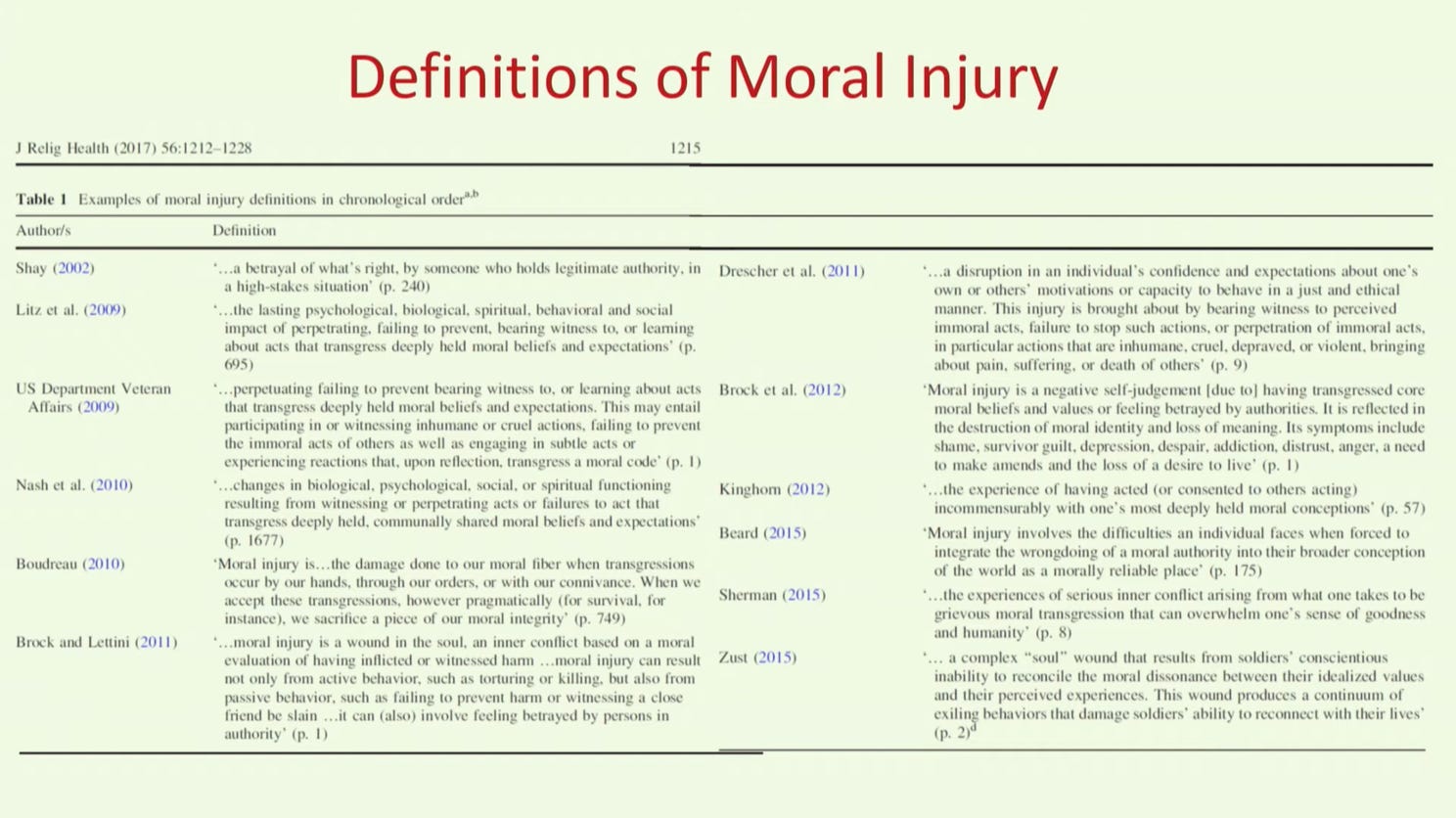
This shows the broad range of work conducted in this field and it is gratifying to reach each definition to see which resonates. What is not included in that table is Steel’s delivery during the presentation of the most efficient definition -
unresolvable emotional conflict
He said this was one of the themes that emerged in a summary of psychiatric literature about WW2 veterans. Really, these three words speak well to the generalised sense of emotional torture and limping through life unable to get away from it.
Regarding treatment efficacy for psychological conditions involving guilt, depression, dissociation and anger, he offered this slide lifted from Key patterns and predictors of response to treatment for military veterans with post-traumatic stress disorder: a growth mixture modelling approach (Psychol Med 2018 Jan;48(1):95-103):
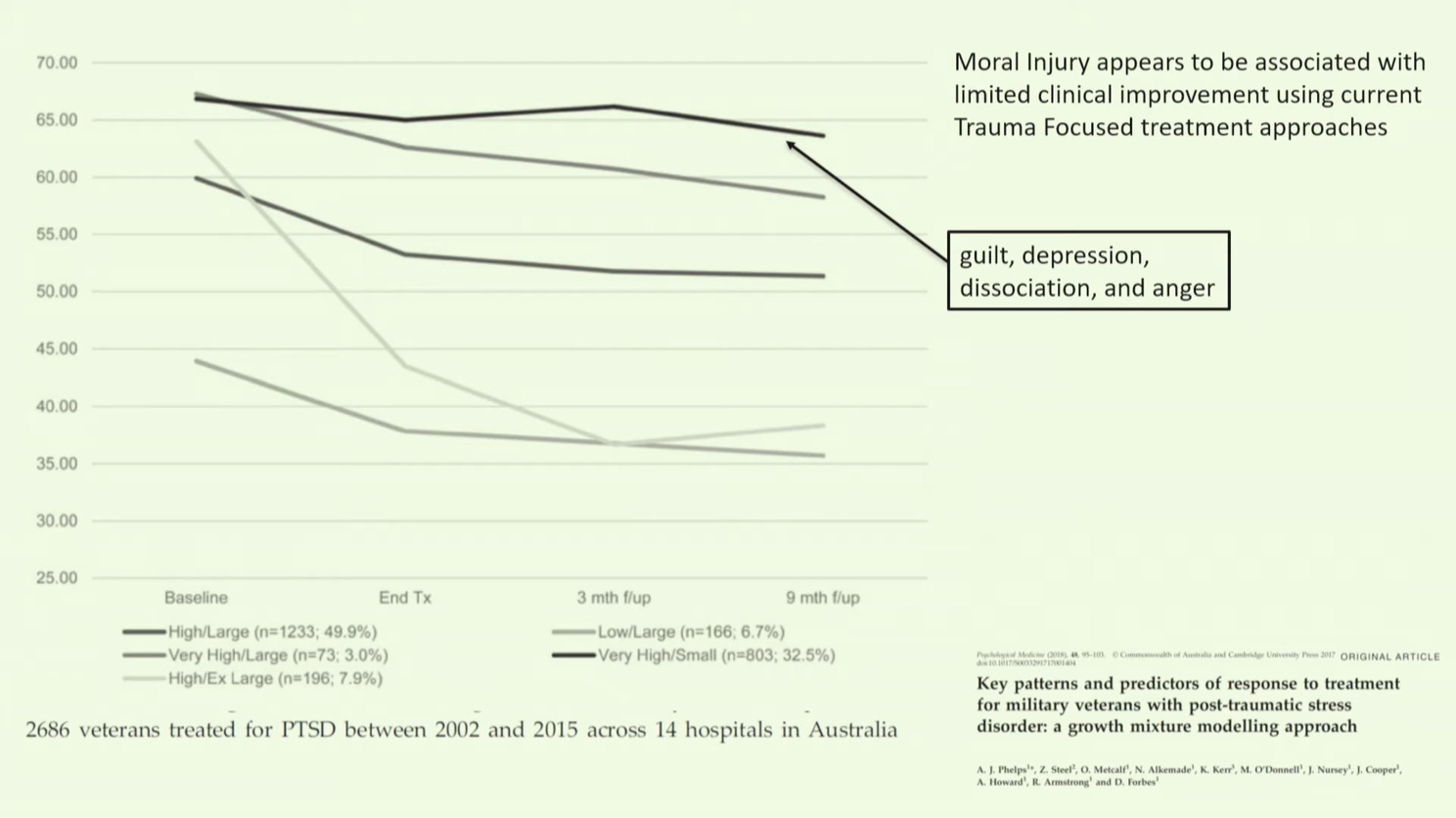
He observes that the chart shows these conditions are the most treatment resistant. He also observed that guilt, depression, dissociation and anger are particularly strongly activated in moral injuries where people failed to prevent, or bore witness to, a betrayal of what’s right. Zeroing in then on the significance of bearing witness to or failing to prevent betrayals of what’s right, he provides the next slide lifted from Distinct Trauma Types in Military Service Members Seeking Treatment for Posttraumatic Stress Disorder (J Trauma Stress 2018 Apr;31(2):286-295):
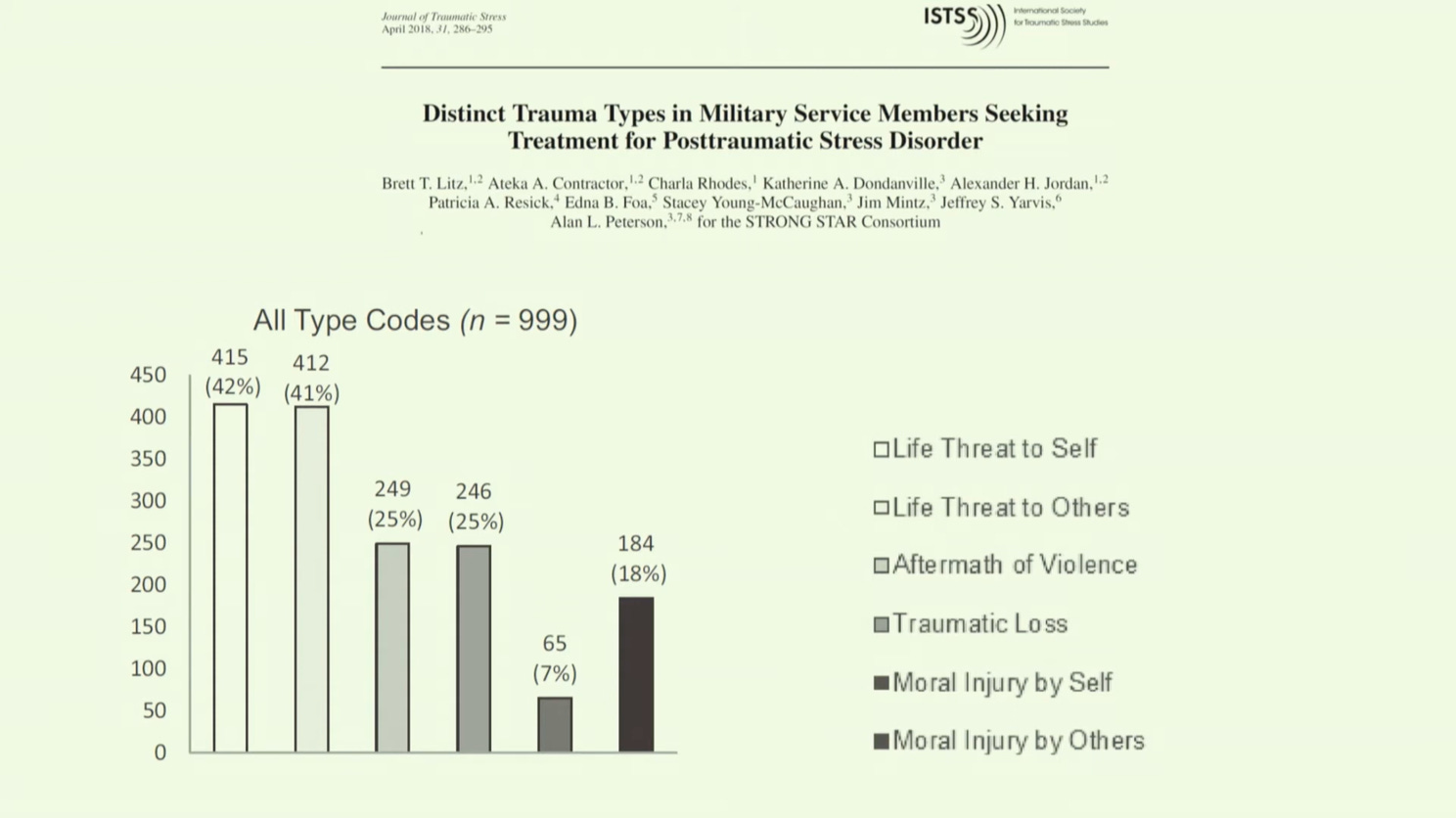
It shows that 7% of soldiers do seek treatment for PTSD when they committed a moral betrayal. Notably, however, more than twice as many seek treatment where they witnessed the commission by others, a category of involvement in moral transgressions by omission. Professor Steel advises that
a lot of what we talk about trauma is witnessing things or being unable to do things yourself
So, there is both commission and omission in relation to an event involving a moral transgression. Commission is where you committed the transgression. Circumstances are clear. The mind is not left to worry about responsibility. Curiously, the intensity of guilt or shame is higher amongst those who found themselves involved by omission. Quoting from his presentation again:
Acts of omission have a lot of interpretive confusion around them. It’s ‘I wasn’t able to do something. I didn’t do something I thought I should do.’ And you know what? It’s invisible to everybody else. It’s invisible to your colleagues. It’s invisible to the people around you. And yet the moral burden that comes from perceived acts of omission - of a failure to do what you thought you should have done - are [associated] with very high levels of ongoing distress.
This is EXACTLY what happened to me. I have only nightmares, sleepless nights, and a toiling rage that developed its own personality, determined to rout every single positive experience it could find ever since 2017.
SIDE QUEST 1: MEDICAL PROFESSION
We have come full circle. I came across the concept of moral injury only 3 months ago when Steve Eisman interviewed Warris Bokhari, MD about Claimable, Inc.:
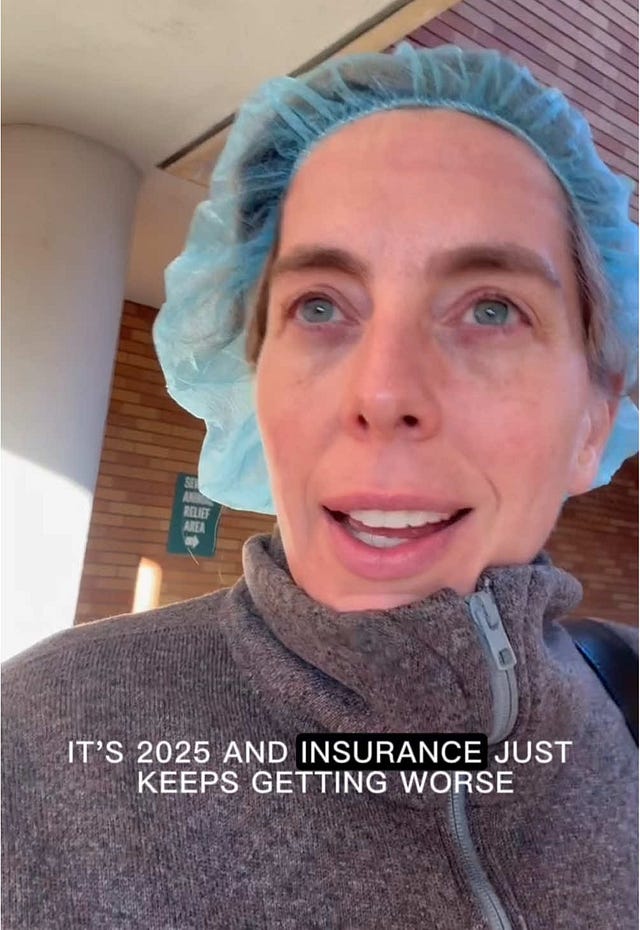
It is interesting to observe this concept making its way around the medical profession in America. It appears to provide doctors with the power to name what is wrong with the lack of universal healthcare. It causes them to betray what is right by, for example, sending patients home before they’ve recovered. Here is Elisabeth Potter, MD going viral about it:
 Tiktok failed to load.
Enable 3rd party cookies or use another browser
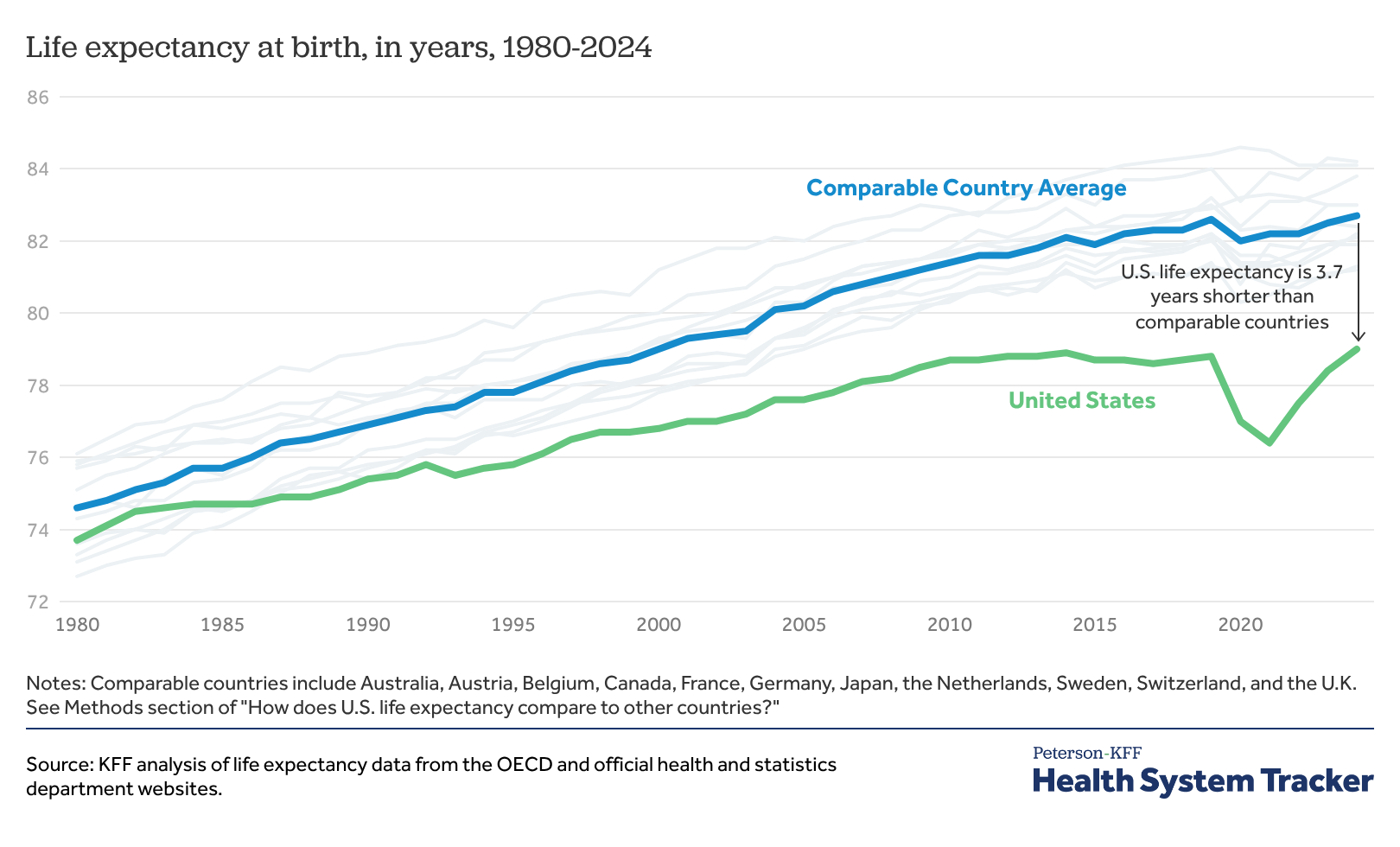
There is an element of leadership malpractice or a legitimate authority directing the betrayal also. For example medical administrators, politicians and insurance executives producing a system that is too hard for doctors to fight in trying to uphold what is right for patients. It is a high stakes situation also - simply put, Americans have a shorter lifespan than those in other rich countries with universal healthcare:
Needless to say, it is really important that doctors are finally able to uphold their oath to care for the sick in America. It is gratifying then to see doctors summoning the rage with this concept, such as Zubin Damania, MD:
Another is Wendy Dean, MD who started Moral Injury of Healthcare. As an indication of her dedication to the cause, she even traded a couple of emails with me and was very straightforward:
Any well-trained therapist can help you work through the sense of betrayal that drives moral injury and the responsibility you assumed that wasn’t actually your weight to carry.
It really helps having a leader not engaging in malpractice! Just reading that simple statement helps me recognise I did in fact attempt to carry a weight that wasn’t mine to carry.
The final stop on this brief tour of moral injury in health care is an exquisite talk by Alina Bennett on Moral Injury on the Front Lines: Lessons From Healthcare:
Two points about helping people recover stood out for me in this excellent talk:
Communalise the trauma - sharing with others who’ve experienced something similar. Trusted listeners are required. These are willing and able to be transformed by a story of someone being sent berserk by a dramatic moral transgression left unmitigated by an authority figure. Why is it necessary that there is willingness to be transformed? She doesn’t make that clear but due to personal experience I understand why. A moral transgression by an authority figure in a high stakes situation REQUIRES CHANGE. That is why someone goes berserk - a loss of inhibition occurs in seeking to cause change because the situation is an emergency. So, the person ideally needs listeners from the community performing the moral transgression who are willing to be transformed.
Ethical listening - others who demonstrate a will and willingness to hear the story. Google DeepMind provides a definition:
...[listening] to grasp meaning, intent, and underlying values, fostering connection and preventing misunderstandings by focusing on the speaker, considering diverse perspectives, and withholding judgment. It involves being present, attentive, and open-minded, recognizing that true understanding serves collective goals and builds stronger relationships and communities.
I have a career of failing to encounter ethical listeners when it comes to leadership malpractice and its attendant moral injuries. I look forward to finding better people through this writing.
SIDE QUEST 2: ADVERSE CHILDHOOD EXPERIENCES
During this research another side quest emerged from Nadine Burke Harris (first to serve in the Office of the California Surgeon General). It is about Adverse Childhood Experiences (ACEs) explaining disease in adulthood:
A great psychologist, Dr. Eric Kuelker, reinforces her points:
I strongly recommend watching both brief talks and then measuring how many ACEs you’ve had using this resource. It. is based on this incredible research by the CDC. A further incredible piece of work by Dr Kuelker is his newsletter about one of the physical illnesses that can result from psychological injury, cancer:
CONCLUSION
So, I have taken you on quite a tour. Let’s distil it. I promised a definition. Moral injury is
...the functionally impairing psychological, biological, spiritual, behavioural, and social impact of perpetrating, failing to prevent, bearing witness to, or being a victim of acts that transgress deeply-held moral beliefs and expectations.
Unexpectedly, it is acts by omission such as failing to prevent or bearing witness to a betrayal of what is right that produce the most intense psychological injuries. Boy do I know this. And how incredibly useful it has been to conduct this research and write about it. For, finally, after 9 years, I am getting a handle on this situation.
Indeed, what I witnessed and failed to prevent did not produce transgressions that were my weight to bear. Leaders engaging in malpractice were everywhere to be seen. The only relevance to me is that, should I ever be required to lead, I will do so in a way that affords emotional equanimity. Importantly, if I cannot achieve this affordance for those whom I lead, I will give up my leadership.