Chapter 6: Leadership, Relationships and Moral Repair.
Introduction
Two important conversations have happened since the last chapter 2 months and 20 days ago. One about excavation safety. The other about persistence. I reflect on these below in the context of leadership, relationships and moral repair.
Excavation Safety
An individual told me recently about a risk of field-based colleagues dying in collapsed excavations. They said their efforts to raise this risk had so far fallen on deaf ears. I was reminded of a couple of excavation safety related incidents in my own career. One was an unshored 10m deep manhole excavation on Public Works Authority ‘Ashghal’ – Qatar‘s drainage network:
When employed at Jacobs a year after recording this video, I took up the issue of this safety hazard because Ashghal was a client of theirs and they had a contract on the drainage system. They were not responsible for the excavation in the video. Nevertheless, I wanted to use the influence of Jacobs to bring attention to the hazard. It led to an investigation by the ethics team where some staff of the company in Qatar were interviewed to get an honest impression of safety standards for that client regarding excavations. That was as far as the company was prepared to take the matter, given they were not responsible for the particular hazard I’d given evidence of. I was not fully satisfied with this resolution, but at least they knew someone was watching.
The second excavation related matter from my career was the death of two men simultaneously, crushed in a trench under a fallen concrete beam. This happened when I was in Kuwait at Amec Foster Wheeler on a Kuwait Oil Company project. Using the moral injury definition discovered in Chapter 2, we can say this contributed to a moral injury via omission, due to bearing witness to (rather than commission of) a transgressive event. I witnessed two such moral transgressions in relation to this event. The first was the men dying in a preventable workplace safety breach. The second was when the leadership called a town hall meeting to celebrate us being nominated as the best project management consultancy by the client, only for the meeting to start with a sombre speech about those deaths. Whereupon the leadership breezily carried on with celebrating our award. Someone in the stunned crowd asked if they would spend money on a rigorous safety training course. The operations director refused to do so, saying it was too expensive. 5 minutes earlier they were talking about 2 dead men in a trench under a concrete beam, then effectively invited us to forget it by continuing blithely on to celebrate our being the best PMC. I was not able to separate the deaths of those men from the failure to spend money on that training. Or from the risk of more deaths. As such, the experience also earned me a check in the box of ‘failure to prevent’ from the overall moral injury definition:
...the functionally impairing psychological, biological, spiritual, behavioural, and social impact of perpetrating, failing to prevent, bearing witness to, or being a victim of acts that transgress deeply-held moral beliefs and expectations (emphasis mine)
In the leadership refusing to fund appropriate extra training, I and others in the crowd who cared to think or ask about the need for it ran the risk of concluding they had failed to prevent further fatalities. In writing this it is the first time I have revisited this matter in detail. It is 9 years later. It has given me some time to think. I will use this moment to state the point of this chapter: appropriate distribution of whose weight it is to carry when a moral transgression must be addressed. I am not directly responsible for the death of these men. I am also not directly responsible for the morally transgressive leadership response to those deaths. There is some resonance for me as I write that statement.
It is a simple remark above from Wendy Dean MD, which I have repeated in each chapter summary. Whose weight to carry was the death of those men? Whose weight to carry was the resulting change to training? The momentum put on a person with a moral injury by omission is that the weight is entirely theirs. This powerful quote from Professor Zachary Steel, also repeated from Chapter 2, explains the resonance:
Acts of omission have a lot of interpretive confusion around them. It’s ‘I wasn’t able to do something. I didn’t do something I thought I should do.’ And you know what? It’s invisible to everybody else. It’s invisible to your colleagues. It’s invisible to the people around you. And yet the moral burden that comes from perceived acts of omission - of a failure to do what you thought you should have done - are [associated] with very high levels of ongoing distress.
Yes, a high level of ongoing distress because a regular person will not be familiar with death. Naturally such a person will have an extreme reaction to a preventable one. I was unfamiliar with death when I went to work in Cambodia, where a lot of preventable deaths occurred historically. Then when I went to work in Kuwait straight after, where they happened regularly right around me in the oilfield.
I can say here that preventable deaths will elicit a great deal of sensitivity and feverish reflection on any possible mistake made. Naturally, every last effort must be made never to participate in someone losing their life. The potential for such rumination is endless in the context of a moral transgression by omission. This is because one was not in control, one only witnessed it, learnt of it, or failed to prevent it. Perversely, that certainty is only available to the person involved in a moral transgression by commission. And Professor Steel’s research shows that this certainty regarding responsibility torments people who commit transgressions less than those involved by omission. They are left without the certainty regarding degree of responsibility. It is remarkably perverse. Basically one may forever be haunted by the thought one didn’t shout loud enough. Or wasn’t aware enough to see the need to shout. And endless variations thereof.
We began above to address the question of whose weight it was to carry the responsibility for these deaths. And the lack of improved training after they happened. Let’s finish addressing the subject of whose weight this was to carry. The weight of those two deaths was carried by the project engineer, the safety engineers, those who participated in the toolbox talk to start the day, and those who incorrectly loaded, or handled, the beam before it crushed the two men. In turn, the weight of the training improvement is carried by the leadership, such as the operations director who refused in front of us to spend money on it. Now, what about the rest of us in that town hall meeting? I will never forget an outspoken colleague. She was an African American woman, who had the courage to speak up for us all and point out that these were not the only deaths. Indeed they were occurring with alarming frequency. What weight does she carry? What about me? What about the other 300 staff standing in shock witnessing all this in that town hall meeting?
I have to be honest with you. We still carried some of the weight. Because if the wrong thing happens, something must be said. Until it is set right, more must be said. If you do not speak, you have said you agree with such moral transgressions. There is more here, but let me make an aside about justice being served.
It was never set right. What followed was a kind of justice though. Due to that and several other deaths met with similar indifference, I resigned from Amec Foster Wheeler. Months later, Wood bought them. Toward the end of the same year Wood was set upon by regulators both sides of the Atlantic due to past bribery at Amec Foster Wheeler to get Brazilian government oil contracts. Not too long afterward, Wood’s stock price traded below the IPO price, undoing all investor gains over more than 2 decades. It never recovered and was bought on the verge of collapse by a consultancy in Dubai, Sidara.
I will return again to the subject of who carries the weight. The point I got to was that several people were responsible for carrying it ahead of me. If it was just me, this is me saying there was no leadership. But there was. I am taking too much responsibility if I ignore them. This sounds elementary. Simultaneously it is hideous to philosophise about how much weight to carry in the face of preventable death. As you watch me ricocheting about here though, you see how severe the unresolvable emotional turmoil is of moral injury by omission. One is reduced to having to spell out the most basic things. It curdles the mind so much that you neglect doing so, possibly for years. Here I am sorting this out once and for all as I write, 9 years later.
An excessive appetite for penance may be taken as a sign of decency. One has to ask though whether effectively removing oneself from circulation through a vast sense of guilt is the kind of justice those who died would want. I actually do think it is possible to say that the decent thing is to be driven insane by such a circumstance. We are then at Alina Bennett’s talk on moral injury, also mentioned in Chapter 2. She spoke of the berzerk state. In witnessing a moral transgression, a person may lose inhibitions in seeking to right the wrong. But let’s continue the thought of what a person who died under preventable circumstances would want. Yes, a form of honouring them is to lose one’s mind with guilt and rage. Honouring them is also possible, however, in appropriately distributing the weight of responsibility, with this guiding acts of change.
We have a final problem. What if the weight of responsibility is rejected, an example of leadership malpractice?
That is what drove me nuts. For in front of me stood white male English, Portuguese and American-accented leaders. They were speaking to a multiracial workforce, the majority of whom were from fragile states with poor employment prospects back home. They failed to step up regarding preventable deaths of two brown men also from a fragile country.
My error here was, in seeing them shirking responsibility, I allowed mine to grow proportionately. Why is that an error? The tools, influence and network available to me were not up to the job. I was a mere GIS Specialist. I was not an executive. For an issue that required executive attention. Simple as that. But because of an overbearing sense of duty I consigned myself to the torture of failing to see progress on this issue due to the total lack of effective tools I had at my disposal.
I now have a story to tell. I was destroyed. It was not the right thing to do to throw myself into the flames of that situation. It might have looked heroic but only one outcome was certain: bent and broken tools and the hands and body wielding them. That was me. Until 30 sessions of therapy.
So then what is the story really? It is a tale of caution about leadership malpractice. Effective leadership is vital. Its absence risks devastation. It cannot be fixed by people without the tools and power of a leader trying to step in. They will end up somewhere between frustrated and broken. It is then on everyone to diagnose good leaders early and get them a position where they’ll be useful. It goes the other way too, identify the potential for leadership malpractice early, implement mitigations.
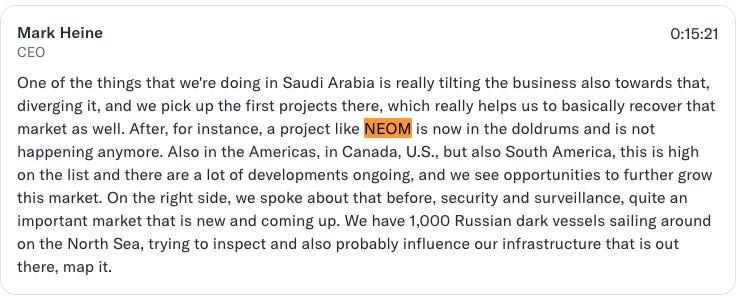
Unfortunately, the world does not provide a perfectly uniform mechanism to create useful leaders. Importantly, in some places, bad leaders encounter ineffective protections against them gaining a position of responsibility. I am reminded of a piece by Rory Jones about NEOM in The Wall Street Journal with an apt title “The World’s Biggest Construction Project Is a Magnet for Executives Behaving Badly: Saudi Arabia’s Neom project contends with corruption, worker deaths, racism and misogyny“.
This is my international career in a nutshell. I spent half of it in places where protections against bad leaders are poor. The results in that article speak for themselves: gang rapes, plural, in worker camps. According to hospital records examined by the reporter. A joyous job.
So, it has been a long story. We started with someone recently telling me their attempts to improve excavation safety at work have fallen on deaf ears. I make these public statements to ensure this individual does not feel alone in challenging an employer to do better in its management of excavation safety risk.
Persistance
A second meaningful conversation happened today. I have a friend in the UK whom I met when working at Arup. He rang me out of the blue this morning from an office in Canary Wharf, London. He proudly showed the view and talked about finally getting a job he had been working towards the past four years. Canary Wharf is London’s new financial district and an elite place to work. It was gratifying to me to receive that call and see the pride on his face, and the nice office design behind him. This is because he is an incredibly talented, hardworking man who was clearly underpaid and under-utilized in the roles he had between when I met him and before today. Whilst I have since moved to a new country, my repeatedly saying a better job was possible meant enough to him that he call me about achieving it on his first day working there.
I am reminded of my own process underway in these chapters to find a better situation myself. Someone whom I had encouraged now serves as encouragement for me.
Moral Repair and Relationships
Here’s to success in the process of moral repair. The previous chapter mentioned a video about this and I will include it again:
The video is useful as it distinguishes between moral reassurance, a common treatment component, and a new treatment approach centred on moral repair. The method is called Adaptive Disclosure - Enhanced. The researcher responsible for it is Brett Litz and his most recent publication on the subject appears to be Service members’ exposure to potentially morally injurious events: Intimate partner knowledge and response. This is apt, given the last chapter concluded with impact on my own relationships.
I am glad to have shown a couple of examples of functional relationships in this chapter. Whilst the first individual confronts a difficulty, what is good is that he saw in me someone he could confide in. This in turn means I have not become a cynic due to what I have both witnessed and failed to prevent. I continue to be someone who speaks up and is then an example to others. I have been taught a valuable lesson though. The role in a team of a leader is a legitimate one. It can be glamorous. The role carries a weight ready to cause an unglamorous descent, however, if we don’t get the choice of leader right through appropriately robust tests.
Neom, for example, incinerated $50 billion before being, according to Mark Heine (CEO of Fugro), cancelled. Bad leaders can cost 10s of billions. And, according to a former colleague, the life of at least one construction worker in, you guessed it, a poorly managed excavation.