

Chapter 2: Definitions: several moral injury definitions exist based on the horrors confronted by soldiers and medical workers, I find the one that resonates.
Chapter 3: Diagnosis: I take the MIOS F to score my moral injury severity, and discuss the implications of a study showing a drop in reasoning capacity for those with moral injury.
Chapter 4: The Moral Transgression Immune Response: reflections on keeping myself from success.
YOU’RE HERE > Chapter 5: The Way Out: working through the sense of betrayal that drove my moral injuries and the responsibility I assumed that wasn’t actually my weight to carry (hat tip Wendy Dean, MD of Moral Injury of Healthcare).
Introduction
In the past week I watched this speech:
It was by Air Force Major Jason Watson. In response to unlawful commands issued to the US Air Force, he called for the impeachment of the president. He has inspired me to engage in some disobedience of my own. Finally I have the wherewithal to write the next chapter in this series.
This chapter is about recovery. It will not be the last. After hesitating for a significant period of time hoping to reach a point of complete recovery, I have realised this process involves several stages. So I will document them chapter by chapter. I will start with the headline for my recovery. I can say I have proof that I have mentally recovered. Funnily enough, there is a connection I can make to this guy being from the Air Force.
FAA Medical
The proof of recovery is in a somewhat curious form! In the past month I passed the US Federal Aviation Administration Class 1 Medical Exam. Should I wish to pursue this career, it means I am fit to be an airline pilot. It was not the plan to certify my recovery in this way. For starters, it cost hundreds of dollars. But I was interested in becoming a pilot and so I did the medical exam. 12 days later I heard back saying I’m fit to fly. It’s opportunistic but I’ll take it also as evidence of a recovery step. Full recovery? Honestly I don’t feel it. But this makes me seem like an idiot. If someone is deemed mentally fit to fly an airliner full of passengers around, shouldn’t I just accept I’m ok?
Let me think about this as I write the background on how I got here.
Therapy
So what happened before the FAA medical? From February to May I completed 20 sessions of psychotherapy. I did this because of watching the presentations by psychologists shown in Chapter 2. As such, I’m putting myself before you not just as someone who’s written some stuff, but using what I discover. I was particularly struck with Eric Kuelker, Ph.D. R.Psych. so reached out to him first. He was gracious enough to have a brief call with me but advised that he is not licensed to practice where I live. Nevertheless, he did recommend that I find a therapist who measured progress with each session. He also said to seek a 5 minute call with several clinicians to check the vibe before spending money. I dutifully then scoured my health insurer’s list of clinicians and tried to call them. This proved tough going. Surprisingly few of their offices picked up the phone. I think I left about 10 voicemails. Only one discussion resulted. It was with a trauma specialist who, amongst other things, administered psychedelics. I am a huge fan of rebellious, indeed disobedient, forms of treatment. When I asked him about having a habit of measurement, though, he said that he didn’t believe in it.
Then I discovered Happier Living, an online therapy service thankfully covered by my insurer. I was able to use their system to find someone with a PhD in psychotherapy. A major source of credibility. Happier Living comes with its own formal measurement system that shows an average state. It has a cheesy name, PERFiC and here is the current state of my dashboard:
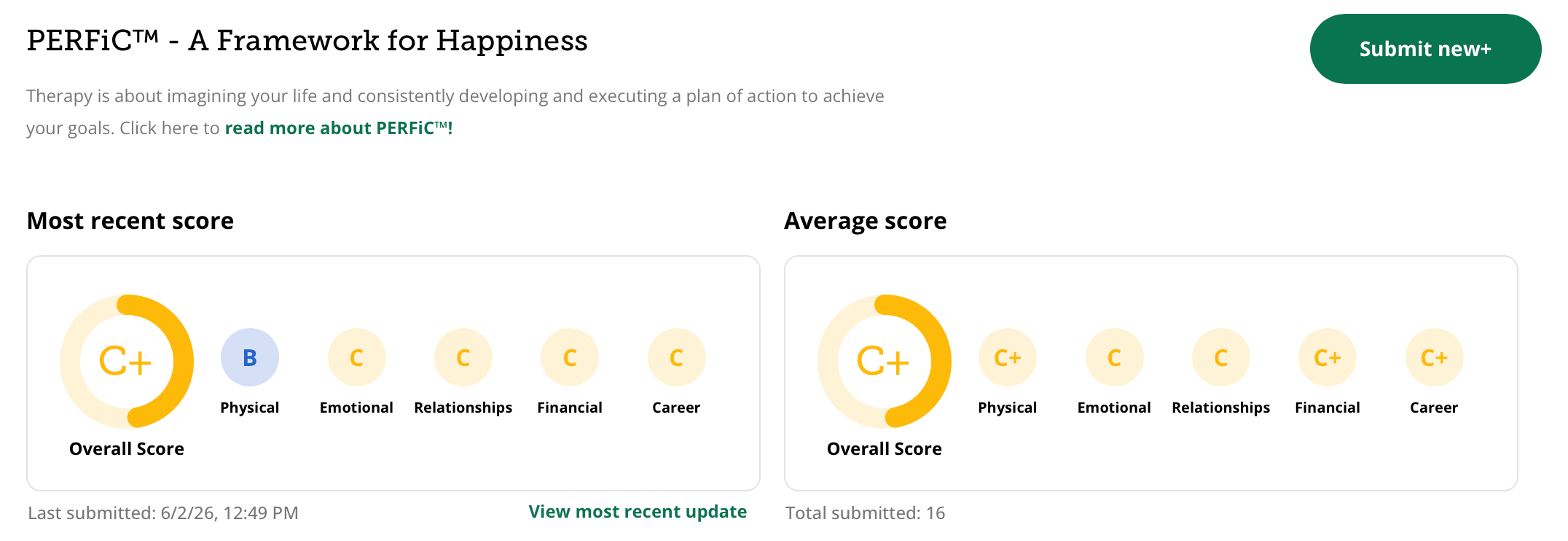
It is relatively rigorous, taking 10 minutes each time if you really think about each item. Importantly it is solely based on what I reported, not also the clinician. It turned out my clinician added two more questionnaires about anxiety and depression on top of that, so measurement was pleasantly thorough. Seeing his training and the facilitation of measurement by Happier Living, I eagerly made my first booking without even seeking out an initial 5 minute chat.
The result of that is captured in Figure 1:
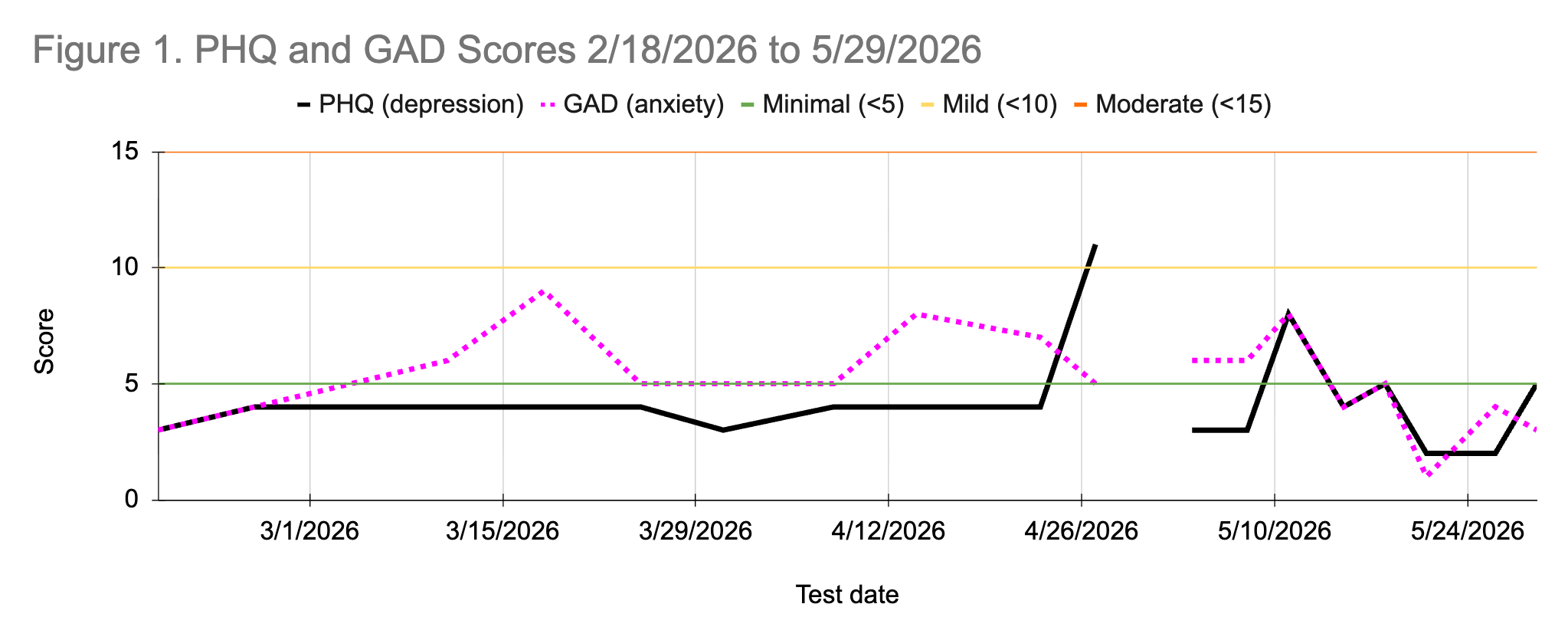
I love the clarity of seeing my experience from session to session as two simple lines on a chart. It tracks depression and anxiety, based on tests I took before each session. After requesting my medical records, I laboriously went through and got all the results for the chart. It shows that, for depression, symptoms were minimal with a temporary spike to moderate in late April. For anxiety, there was a prolonged stretch in the mild zone from early March to late May. This meant a generally higher baseline than depression. Recently, both are tailing off toward minimal. Depression on the last measurement was mild but there was a distinct drop from moderate symptoms end of April to between minimal and mild at the end of May. Anxiety for the first time in two months dropped to minimal.
This can be contrasted with my PERFiC score above, C+, after 16 measurements (yes, I missed 4). One might expect a higher subjective rating via the PERFiC scores to accompany the improvement in anxiety and depression measured by the other two instruments the clinician used. Mental and emotional life is messy. It seems useful to have multiple ways to examine it. Perhaps, also, my PERFiC scores measure life satisfaction and this can remain low despite clinical symptoms being low or absent. My impression is that with consistent achievements in lowering clinical symptoms, life satisfaction will eventually pick up. My beginning to go test the waters of a new career as a pilot is an example here.
It was a great experience having a therapist and surprisingly cheap - only $40 a session for me to pay with the rest covered by insurance. In May I chose to increase the frequency to twice a week as I wanted to start going through a moral injury treatment protocol developed by Brett Litz. This paper describes it as Adaptive Disclosure - Enhanced. He gave a useful lecture on it. Wrote a book. Even did a podcast. This video is an easily understood summary, contrasting mere moral reassurance with moral repair:
A figure from the paper linked to above sums up the advantage of Adaptive Disclosure-Enhanced (AD-E) over another treatment, Present-Centered Therapy (PCT):
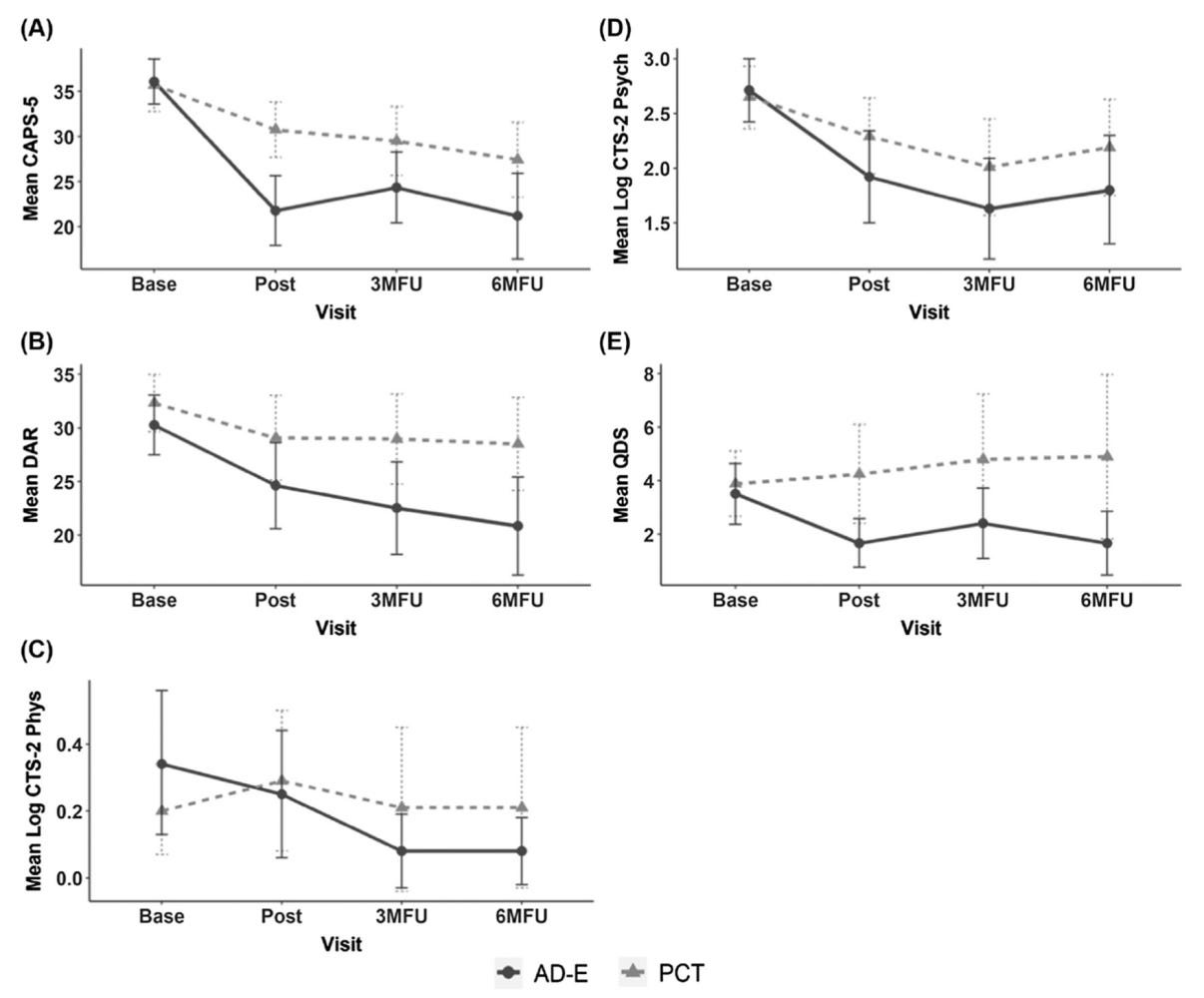
From this it was clear to me I should pursue this type of treatment. So I kept the regular weekly session to discuss whatever came at me in every day life and added another to start AD-E. How did that go? Honestly not very well. As in, the clinician saw that I was too activated by the moral transgressions I’d come across in my career, and the result of that ricocheting around my relationships, to move beyond the first stage of AD-E. So the sessions revolved around developing skills to register emotional effects, and notice how those propagated through my responses to people and situations. This doesn’t sound like a lot. But it is powerful.
It helps if it is not a surprise when it starts raining. You can take an umbrella. Then you are more comfortable by not getting wet so much. It wasn’t just me sensing the rain and hoisting the umbrella though. It was helpful having a therapist there twice a week giving me a space to name what was going through me. And for coaching and challenging me on beliefs.
Through all this, the focus of the sessions became relationships. That is where I struggle most in life. The sessions served as a regular check in point to anchor or baseline on the state of them. They functioned as a regular sampling event. Through this, I saw a cycle which I hadn’t been aware of before. With this awareness I was able to begin to anticipate things. And the result? The reduction in anxiety from persistently mild to minimal at the end of the chart above. I recognised a cycle for the first time, and began to anticipation the results of it. I was no longer in a state of surprise every couple of weeks about the state of my relationships. In one of the last couple of sessions the clinician commented observing a new feeling of calm and confidence in me. That is what it looks like going from 2 months of mild anxiety to minimal on the dotted pink line of the above chart.
Am I Satisfied?
I said above I would think about whether having the Federal Aviation Administration say I’m mentally fit to pursue a career as a pilot means I am satisfied that I’ve recovered. I should not take their opinion lightly. It is exciting to know I’ve satisfied them. It is thrilling to think about being a pilot. I have to share a story here. The medical examiner was a woman who herself had a pilot license and her own plane. One of her lines of business is FAA medical exams. She flew her plane multiple times a week between two airports where she had clinics. What a career! In her I have inspiration to give my daughter about what is possible in life. The doctor also introduced me to a pilot who did a career transition out of engineering. This is similar to what I am considering. I will be calling him this week as inspiration for myself.
Ok, so that’s undeniably uplifting. But there are a couple of things I’ve written above that a rigorous reader would be asking questions about.
Adaptive Disclosure-Enhanced enables not only moral reassurance but moral repair. I admitted that I did not get far with this therapy as the moral transgressions were too activating for me to progress beyond simply naming and observing the emotions that came up, and relationship impacts.
On relationships, I mentioned becoming aware of a cycle that regularly, negatively affects my life. Only through an intense 20 sessions of therapy at a rate of twice a week did I bring mild anxiety down to minimal in this context.
So, let’s be honest. An effective therapy for moral injury, Adaptive Disclosure-Enhanced, has only been started, not completed. Being about moral repair, it offers a powerful identity rebuilding function. This is necessary in the face of repeated and grave moral transgressions that I have variously witnessed, failed to prevent or been the victim of. As you are aware from Chapters 1 and 2, these transgressions occurred during an international career in Kuwait in 2013-2017. But what I haven’t told you is that these continued in the UK when I worked at Jacobs in 2022-2024. This is recent, and gives context for the discovery through therapy of a regular impact on my life driven by relationships.
I have not only got a repair job to do on my identify, but also my relationships because of the impact of moral transgressions put upon me by leaders engaging in malpractice. This means any other career, not just being a pilot, is attractive. The thought of dropping out of the engineering consulting industry is a relief due to all of its moral terrors.
Why?
Jacobs is a NEOM delivery partner. It is a project involving human rights abuses. Like putting tribal landowners on death row to make way for the project. I fought Jacobs and lost when trying to get them to help take these guys off death row. The fight had straightforward consequences for my marriage and being a great father. In other words, a moral injury at Jacobs deeply affected my most important relationships.
See you in the next chapter.
Best wishes to Major Jason Watson.
That is a powerful and honest share. Bravely exhibiting self for the education and awareness of others. Considering change and engaging in the formal practice of changing. I can only support your efforts by saying that engagement in self, with others -- clearly indicates an affinity for service, love, and support -- often these are given. Perhaps some are not good receivers .. but the need and efforts in giving are worthy of continuing. Everyone's compass of life often spins from North as the magnetism of the mass is continually creating interference .....